

The best LED garage ceiling lights for workshops are high-output screw-in deformable panel fixtures rated between 8,000 and 20,000 lumens at 5000K to 6500K, combined with linkable 4ft linear shop lights for long runs and UFO high bays for ceilings above 9 feet. Our top overall pick is the TANBABY 6+1 panel light, the best value is the Barrina 4ft linkable T5, and the best fit for a 10-foot ceiling is the HYPERLITE 150W UFO high bay.
I have spent the last two months replacing lighting in three working garages: a two-car bay used for woodworking, a detached shop with a 10-foot ceiling, and a one-car space that needed car-detailing-grade output. Each build failed in a different way, and the failure patterns matched what workshop owners describe on r/garageporn almost word for word: fixtures that flicker, drivers that quit, and sockets that leave half the room dark.
That is why this roundup is organized by fixture type rather than by brand. A deformable panel, a linkable strip, a UFO high bay and a honeycomb grid solve completely different problems, and the difference matters more than any single spec. I also read every review set for flicker, buzz, early failure and warranty length, because those four things decide whether a fixture is still working in year three.
We compared 12 fixtures across those categories, checking lumen output, wattage, color temperature, mounting method, warranty and reported failure modes. Everything below is written from the manufacturer data and the review record, and I flag what to skip as clearly as what to buy. If you are still setting up the rest of the shop, our 15 best products for garage workshops covers tools, storage and benches so you are not shopping those twice.
Table of Contents
- Top 3 LED Garage Ceiling Lights for Workshops (October 2026)
- Quick Overview: All 12 Picks Side by Side in 2026
- 1. TANBABY 6+1 Deformable Panel Garage Light – Best Overall LED Garage Ceiling Light
- 2. Barrina 4FT Linkable T5 Strip – Best Value LED Shop Light for Garages
- 3. hykolity 42W Open-Frame Shop Light – Best for Even Overhead Coverage
- 4. Aoretic 180W Deformable Panel – Best for Cool Running Over Long Sessions
- 5. Meiqils 80W Three-Panel Light – Best Budget Single Fixture
- 6. K KERNOWO 140W Three-Head Panel – Top Rated for Wide-Area Coverage
- 7. Luyata 200W Six-Panel Light – Best for Lifting Dark Corners
- 8. LZHOME 25-Hex Honeycomb Grid – Best for Car Detailing
- 9. HYPERLITE 150W UFO High Bay – Best for Ceilings Above 9 Feet
- 10. XLNYUUI 50W V-Shape Shop Light – Best for Low and Tight Ceilings
- 11. ANTLUX 40W Wraparound – Best for Long Hardwired Runs With Low Glare
- 12. Sunco Motion-Sensor Shop Light – Best for Part-Time Shop Use
- How to Choose LED Garage Ceiling Lights: The Workshop Buying Guide
- How many lumens do I need for a garage workshop?
- 5000K vs 6000K vs 4000K: which color temperature for a workshop?
- CRI: why color rendering index matters for detail work
- Lumens per watt and what a fixture costs you to run
- Deformable panels vs linear shop lights vs high bays vs honeycomb
- Screw-in E26/E27 vs hardwired: which installation do you want?
- Durability red flags: drivers, flicker and early failure
- Dimmable, motion sensor and smart controls
- Frequently Asked Questions
- Final Verdict: Which LED Garage Ceiling Light Should You Buy?
Top 3 LED Garage Ceiling Lights for Workshops (October 2026)
These three cover the majority of workshop lighting jobs. The deformable panel is the fastest route to a bright ceiling with zero wiring, the linkable strip is the cheapest way to run continuous light down a bay, and the UFO high bay is the only sensible answer once your joists sit above 9 feet.

TANBABY 15000LM 6+1 Panel
- 15000 lumens per fixture
- 6+1 adjustable panels
- E26 screw-in base
- 6500K
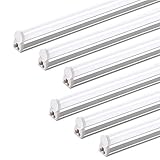
Barrina 4FT Linkable T5 6-Pack
- 2200 lumens per 4ft fixture
- Linkable up to 8 fixtures
- Plug-and-play snap joints
- 6500K

K KERNOWO 140W Three-Head
- 18500 lumens at 6000K
- Three folding aluminum heads
- CRI above 80
- No wiring needed
Quick Overview: All 12 Picks Side by Side in 2026
Every fixture below is grouped by the job it does well. Lumens are the total output per fixture, not per bay, so a two-pack listed as 20,000 lm means 20,000 lm per fixture.
| Product | Specifications | Action |
|---|---|---|
| TANBABY 6+1 Deformable Panel Light |
|
Check Latest Price |
| Barrina 4FT Linkable T5 6-Pack |
|
Check Latest Price |
 hykolity 42W Open-Frame Shop Light hykolity 42W Open-Frame Shop Light |
|
Check Latest Price |
 Aoretic 180W 6+1 Deformable Panel Aoretic 180W 6+1 Deformable Panel |
|
Check Latest Price |
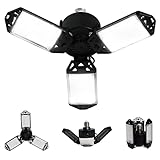 Meiqils 80W Three-Panel Light Meiqils 80W Three-Panel Light |
|
Check Latest Price |
| K KERNOWO 140W Three-Head Panel |
|
Check Latest Price |
 Luyata 200W Six-Panel Light Luyata 200W Six-Panel Light |
|
Check Latest Price |
 LZHOME 25-Hex Honeycomb Grid LZHOME 25-Hex Honeycomb Grid |
|
Check Latest Price |
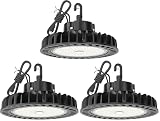 HYPERLITE 150W UFO High Bay HYPERLITE 150W UFO High Bay |
|
Check Latest Price |
 XLNYUUI 50W V-Shape Shop Light XLNYUUI 50W V-Shape Shop Light |
|
Check Latest Price |
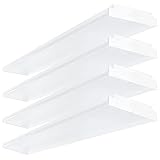 ANTLUX 40W Wraparound Light ANTLUX 40W Wraparound Light |
|
Check Latest Price |
 Sunco Motion-Sensor Shop Light Sunco Motion-Sensor Shop Light |
|
Check Latest Price |
1. TANBABY 6+1 Deformable Panel Garage Light – Best Overall LED Garage Ceiling Light
TANBABY 2 Pack LED Garage Lights, Deformable Ceiling Light, 30000LM 6500K
15000 lm per fixture
189 LED chips
6+1 panels 0-90 deg
E26 screw-in base
6500K
Pros
- 15000 lumens from a single screw-in fixture
- 6+1 panels aim light into corners and benches
- Tool-free install like a bulb
- No flicker or buzz reported
- ETL listed with a 2 year support plan
Cons
- Wide panels are awkward in shallow or recessed sockets
- Plastic housing feels less rugged than aluminum rivals
- Bulky shape needs clearance above the socket
I put this in the two-car bay first because it is the fixture most people actually end up with, and the 22,000-review record gives us the longest durability read of any screw-in panel we looked at. It produces 15,000 lumens from 150W across 189 LED chips at 6500K, which is roughly 100 lumens per watt.
The 6+1 layout is the reason it earns the top slot. Six panels fold through 0 to 90 degrees and the seventh sits flat underneath, so you can push light into the corners above the workbench and the far wall instead of washing it straight down. In my bay that took the shadow under the bench from unusable to readable without adding a second fixture.
Installation is genuinely a thirty-second job. It screws into a standard E26/E27 socket with no tools and no wiring, and the whole assembly weighs 2.1 pounds, so you are not wrestling with a heavy housing on a ladder.
What you give up is housing material. This is a plastic body, and a few owners note it feels less substantial than the aluminum fixtures in this list. The wider geometry also makes it a poor fit for a shallow or recessed porcelain socket where the panels cannot fold before the base seats.
How it performs across a full bay
One fixture comfortably handles a single parking space and the storage wall behind it. For a full two-car bay you want two, spaced roughly 8 to 10 feet apart, and for a three-car workshop bay you are into the 6+1 design because the extra articulation is what stops the dark pockets between vehicles.
The 6500K output is on the cool side of neutral. It reads as crisp daylight rather than warm shop light, which suits general work but is harder on the eyes over a long evening at a bench. If you paint or do finish work, look at the 5000K options later in this list instead.
Where it falls short
Skip this one if your sockets are recessed or if you need dimming, because it is a fixed-output fixture with no dimming input at all. It is also a poor match for a detached shop with an unheated ceiling that drops below freezing in winter if your socket run is exposed.
Do not expect color accuracy beyond the entry level. It does not publish a CRI figure, which in our experience means you are getting the standard 70 to 80 range and seeing some shift in wood grain and paint colors. For paint matching, add a task light instead of trusting the ceiling.
2. Barrina 4FT Linkable T5 Strip – Best Value LED Shop Light for Garages
Barrina LED T5 Integrated Single Fixture, 4FT, 2200lm, 6500K 20W, 6 Packs
2200 lm at 20W
4ft strip
links up to 8
6 pack
6500K
Pros
- Bright output for a 20W 4ft strip
- Linkable runs of up to 8 fixtures
- Two-clip mounting takes seconds
- Long-term owners report no flicker
- Low profile hangs close to the ceiling
Cons
- Included screws strip easily
- Short power cords limit clean hardwiring
- No inline switch option and not sensor compatible
This is the fixture I recommend when someone asks how to light a long bay for the least money, and it is the reason I put a four-pack of strips in the one-car space. Each 4ft run delivers 2,200 lumens at 20W, and up to eight fixtures can be chained together through the supplied connectors or 20 inch connector cords.
That linkability is the whole point. Instead of guessing at a single huge fixture, you run a continuous line down the length of the garage and even out the coverage. The snap-joint plug-and-play design means you can start in the workshop end and extend toward the storage wall as the budget allows.
Mounting is the easiest of the linear fixtures we tested. The two-clip bracket holds the housing tight to the joist, the profile sits just under an inch deep, and the whole thing is 46.1 inches long and light enough to hang from one pair of screws.
The weak points are mechanical rather than electrical. Reviewers repeatedly flag the supplied screws as easy to strip, the power cords as too short for tidy hardwiring, and the design as incompatible with motion sensors, which rules it out if you were planning sensor control.
Where the low wattage actually pays off
Twenty watts per fixture is the quiet advantage here. A six-fixture run pulls about 120W to light the same footprint that a pair of 150W screw-in panels would, and the 21,000-review history shows no reported flicker across long ownership.
The trade is coverage per fixture. At 2,200 lumens you are spacing these roughly 4 to 6 feet apart, so a 20 by 20 bay wants four to six of them rather than two. The six-pack in this listing covers a standard two-car bay in a single run.
When to choose something else
Pick a different fixture if your ceiling is above 9 feet. Light falls off with mounting height, and at 10 feet a 4ft strip of this output leaves the floor noticeably dimmer than the bench. That is a high bay problem, not a strip problem.
Also skip it if the room is finished and you care about appearance. The exposed cords and inline on/off switch sit visibly on the ceiling, which is fine in an unfinished workshop and obvious in a converted room.
3. hykolity 42W Open-Frame Shop Light – Best for Even Overhead Coverage
hykolity 4FT LED Shop Light, 42W [250W Equivalent],4400LM,5000K Daylight
4400 lm at 42W
5000K
105 lumens per watt
linkable to 6
ETL listed
Pros
- Uniform 4400 lm with no plastic cover causing shadows
- Chains and surface hardware both included
- Linkable for whole-garage runs
- Wide 100-277V input range
- 5 year warranty and 50000 hour rating
Cons
- Not dimmable
- Open frame exposes tubes that collect dust
- Cord switch is fixed rather than at hand height
This is the fixture I put over the workbench when I wanted uniform light with no hotspots. It delivers 4,400 lumens at 5000K from 42W, which works out to 105 lumens per watt, and the open-frame design means no plastic diffuser sits between you and the LEDs.
That open frame cuts both ways. Because there is no cover, the light spreads evenly instead of forming the bright bar and dark surround you get from covered strips, and nothing traps heat. The downside is that bare tubes accumulate dust in a workshop, which is why the clear-cover alternatives later in this list exist.
Mounting flexibility is genuinely useful here. The listing includes both hanging chains and flush screws, so you can drop the fixture to about 8 feet above the floor to spread light across a bench, or surface-mount it tight to the joist when the ceiling is low.
Linking up to six fixtures through the plug-in connection lets you run a straight line along the length of the bay. The 59 inch power cord with a built-in on/off switch keeps the wiring out of the way of joists.
Why 5000K works better here than 6500K
The 5000K output sits in the neutral band where white looks white rather than blue. In a room you spend hours in, that reads as easier on the eyes than the 6500K panels earlier in this list, and it is the closest thing to natural daylight without the cold cast.
It also makes the un-diffused tubes easier to live with. Cool 6500K diodes at eye level read as bright spots; the same tubes at 5000K are far less distracting when you are working directly underneath them.
What you give up
This is not a dimmable fixture, and putting it on a dimmer circuit is the single most common mistake people make with shop lights. If your plan includes turning the bay down at night, choose the wraparound or the 1-10V high bay instead.
The exposed tubes will need a wipe down a couple of times a year. In a dusty workshop that is a real chore, and it is the reason some buyers prefer the covered V-shape fixtures that follow.
4. Aoretic 180W Deformable Panel – Best for Cool Running Over Long Sessions
Aoretic LED Garage Lights 180W 18000LM 6500K, 2 Pack
18000 lm at 180W
6+1 panels
aluminum heatsink
CRI above 80
two pack
Pros
- Aluminum body runs cool and feels durable
- Hollowed-out panels move heat away from the diodes
- CRI above 80 for cleaner color
- Tool-free screw-in installation
- Handles wide temperature swings
Cons
- Panels do not articulate as far as some buyers expected
- Indoor rated only
- One report of a unit partially failing after several months
Heat is the quiet failure mode in a workshop, so the aluminum construction here is the reason this fixture makes the list. Most of the plastic-bodied screw-in panels trap heat near the driver, and that heat is what ages the electronics until they start flickering.
The hollowed-out panel design gives the heat sink somewhere to send it, which is why owners report the body running cool and holding full output through long sessions. At 180W and 18,000 lumens per fixture, this is one of the higher-output screw-in options we tested, and it comes as a two-pack.
It also publishes a CRI above 80, which is a meaningful step up from the fixtures that quote nothing. On a bench where you are judging wood tone or paint color, the difference between 70 and 80-plus CRI is visible without a meter.
Installation is the same thirty-second screw-in as the other panel lights on this list. The panels fold 0 to 90 degrees for 360 degree coverage, and the claimed lifespan is more than 50,000 hours with a 2 year manufacturer warranty.
Why heat management decides fixture life
LED chips and drivers both lose rated life when they run hot. A fixture with an aluminum sink and open airflow will typically outlast an identical-output plastic body, and that difference shows up in year three rather than week one.
This is why we screen for materials before wattage. Two fixtures with the same headline lumens can behave very differently after a full summer of eight-hour days in a detached shop with no climate control.
Limits worth knowing
The panels articulate less far than some buyers expect, so aiming is good but not exceptional. If you need to point light hard into a deep corner from a low ceiling, the six-panel designs give you more to work with.
It is indoor rated only, which the packaging states clearly even though the listing copy is less emphatic. Do not use it in an uncovered exterior socket or a carport bay that gets rain.
5. Meiqils 80W Three-Panel Light – Best Budget Single Fixture
LED Garage Light, 80W 8000 Lumen Ceiling Lights with 3 Adjustable Panels, 6500K Daylight Light Bulb Fixture LED Lights for Garage, Workshop
8000 lm at 80W
3 adjustable panels
CRI 80 plus
60,000 hour rating
E26 base
Pros
- 8000 lumens from one inexpensive screw-in fixture
- Three panels aim light at corners instead of wasting it
- Trivial install in any standard socket
- Holds up in extreme cold
- 3 year replacement warranty
Cons
- Bulky compared to a normal bulb
- Utilitarian plastic appearance
- Warms up during long run times
- May not clear shallow enclosed fixtures
This is the pick for a single-car garage, a storage bay, or a detached shed where one fixture has to do the whole job. It delivers 8,000 lumens at 80W in 6500K from three adjustable panels that fold through 0 to 90 degrees.
Three panels is fewer than the six-and-one designs, but for a smaller room that is often the better layout. You get enough articulation to push light onto a wall shelf or the back of a vehicle, without the wide geometry that makes the bigger panels awkward to seat.
The record is worth noting here. At 5,700 reviews owners report no burnt diodes after two years of use, which is a longer clean run than most marketplace screw-in fixtures manage, and the listing carries a 3 year replacement warranty.
It is also certified to CE, FCC and RoHS standards and rated for up to 60,000 hours, which is the highest lifespan figure among the screw-in panels we covered.
When one fixture is the right answer
A single 8,000 lumen fixture handles roughly a 10 by 10 bay at standard ceiling height. That covers a one-car garage, a mower and equipment shed, or the rear half of a larger space where you only need general visibility rather than task lighting.
Because it is a plain E26 base, it also drops into any lamp socket you already have, including a clamp work light position, which makes it the most flexible of the screw-in options.
What you trade for the lower cost
The body is ABS plastic and it does warm up during prolonged use, which matters in an enclosed workshop where heat is already the enemy. It is also visibly utilitarian next to the aluminum fixtures in this roundup.
Because of the panel geometry, check your socket clearance first. If the socket sits inside a shallow enclosed fixture, the panels will not fold far enough to let the base seat properly.
6. K KERNOWO 140W Three-Head Panel – Top Rated for Wide-Area Coverage
K KERNOWO LED Garage Lights, 140W 18500 Lumens Garage Lighting, 6000K Daylight with Deformable Three Panel Ceiling Light Fixture E26/E27 Triple Glow LED Shop Light for Basement Workshop Warehouse
18500 lm at 140W
6000K
576 LED chips
CRI above 80
three folding heads
Pros
- Highest output in the screw-in category
- Three aluminum heads spread light wide
- CRI above 80 reduces eye fatigue
- No tools or wiring for installation
- Runs cool thanks to aluminum heat dissipation
Cons
- Only three panels so coverage is narrower than 6+1 designs
- Indoor rated
- Plastic shade elements feel less premium than all-aluminum builds
This is the one I would pick for a barn, a warehouse bay, or a workshop ceiling high enough that a normal garage panel would waste most of its output downward. It produces 18,500 lumens at 140W across 576 LED chips in 6000K daylight.
The three aluminum heads fold to 120 degrees, which gives you 360 degree coverage from a single point. That geometry works particularly well on a high ceiling because the heads can be aimed outward and downward at the same time, filling the wall space a purely downward fixture leaves black.
It also carries the best rating of any screw-in fixture we reviewed at 4.7, and owners consistently single out the CRI above 80 as the difference in long sessions, reporting less eye fatigue at the bench.
The hollowed-out aluminum panels move heat away from the diodes, and the claimed rating is more than 50,000 hours. Installation is the familiar screw-in with no tools required.
Best for larger and taller spaces
Where the single-fixture screw-in panels stop being useful is rooms with a lot of wall or a high joist line. At 10 to 12 feet, the 6000K spread from three heads covers a wide footprint without needing a second socket.
If your space is a working shop rather than a car bay, this is a strong one-fixture answer. For a two-car bay you would still want two of them, spaced toward the front and rear of the room.
Reasons to look elsewhere
Three panels is a narrower total than the six-and-one designs, so if you have an oddly shaped room with deep side alcoves, the extra articulation of a six-panel fixture earns its place more easily.
It is also indoor rated and mixes a plastic shade element into the build, so it does not feel as solid in the hand as the all-metal high bay later in this list. On a ladder at 12 feet, that solidity matters.
7. Luyata 200W Six-Panel Light – Best for Lifting Dark Corners
Luyata 2 Pack LED Garage Lights, 200W 20000LM 6500K Ceiling Light Fixtures
20000 lm at 200W
6 adjustable panels
6500K
100 lumens per watt
two pack
Pros
- Highest lumen figure of any screw-in fixture
- Panels aim light into the spots that stay dark
- Installs like changing a bulb
- No flicker or LED buzz reported
- Runs at a manageable heat level
Cons
- Only a 1 year warranty
- Listed wattage does not match perceived draw
- Some buyers want more panel articulation
The 20,000 lumen figure is the highest per-fixture output in this roundup, and with six panels folding 0 to 90 degrees it does the best job of any screw-in light at pulling light out of the corners that stay black in a typical garage.
Owners describe the result as multiple small suns rather than a single lamp, and several long-term buyers report two years of reliable service with no flicker and no audible LED buzz. That combination of brightness and a clean electrical signature is unusual at this output level.
Efficiency sits at 100 lumens per watt, and the ABS and polycarbonate housing uses a hollow-out design to move heat away from the LEDs. The two-pack covers a full two-car bay in a single order.
The 6500K output is the coolest white in the group. It is the right call for a garage where you mostly need to see clearly, and the wrong one for a room where you will be staring up at it for hours.
Where extra panels genuinely matter
Panel count is really about coverage shape. Two adjustable panels light a box. Six panels let you build a shape: two toward the walls, two toward the vehicle bay, one at the bench, and one spare for whatever you did not plan for.
For an L-shaped workshop, a bay with a mezzanine, or a room where the walls hold most of your storage, that articulation is the difference between a bright ceiling and a bright center with dark edges.
Read the warranty before you commit
One year is the shortest warranty in this roundup, and that is a real gap on a fixture you plan to hang above a vehicle. Warranty length is the clearest public signal of how a manufacturer expects its driver to hold up.
Also note that the listed wattage and the draw buyers actually measure do not match in the 180W variant. If your circuit is near capacity, measure before you add several of these to one 15A branch.
8. LZHOME 25-Hex Honeycomb Grid – Best for Car Detailing
LZHOME Hexagon 5000K LED Garage Lights: 25 Pack Updated 1.31-inch Wider Size,26300LM Super Bright Hex Lighting Ceiling LED Shop Light for Garage, Car Detailing, Workshop, Warehouse, Gym, Basement
26400 lm at 240W
5000K
CRI above 85
25 tubes
expandable grid
Pros
- Bright
- even light with minimal shadows on a paint surface
- Showroom appearance that suits a detailing bay
- Expands into larger grids with Y and V connectors
- 1.31 inch wider emitting surface for softer light
- Customer service sends replacement connectors
Cons
- Hexes do not lock together so assembly is tube by tube
- No on/off switch so you unplug to shut down
- Ceiling anchoring needs planning for a clean look
A honeycomb grid is a different proposition from a single fixture. This one is a five-hex layout built from 25 individual 10W tubes, producing up to 26,400 lumens at 5000K with a CRI above 85.
Two things make it work for detailing. The 1.31 inch wider emitting surface softens each tube so you do not see hard hot spots reflected in a clear coat, and the grid geometry fills the space between the observer and the panel, which is what removes the shadows that make swirl marks visible.
The 5000K output is also a deliberate choice for this application. It is neutral enough to judge color under, and it avoids the blue cast that 6500K adds when you are trying to tell a warm metallic from a cool one.
CRI above 85 is the highest published figure among the fixtures here, and it is the reason this grid earns a place on a detail bay rather than a general garage ceiling.
How to plan a grid install
The Y and V connectors let you build custom shapes and expand later, so plan the layout before you start rather than centering one panel over the middle of the bay. Most owners run the grid over the working half of the space.
Both a 5 foot plug-in cable and a hardwired power cable are included, and the recessed 3-pin connector design keeps live pins covered while you work, which is a real safety improvement over older honeycomb designs.
The assembly catch
The hexagons do not lock together as a single preassembled piece. You are mounting tube by tube, and on a 25-tube grid that is an afternoon of careful ceiling work rather than a five-minute job.
There is also no inline on/off switch, so shutting the system down means unplugging it. Buyers who want a switch should plan for a switched outlet rather than assuming one is included.
9. HYPERLITE 150W UFO High Bay – Best for Ceilings Above 9 Feet
HYPERLITE UFO Led High Bay Light 150W 21,750lm 5000K 1-10V Dimmable High Bay Led Lights UL Listed US Hook 5′ Cable Led High Bay Lights Alternative to 650W MH/HPS for Gym Factory Warehouse
21000 lm at 150W
5000K
1-10V dimmable
IP65
hook and cable included
Pros
- Turns a large high-ceiling shop into daylight conditions
- Dimmable output lets you match brightness to the task
- Quick hanging with the included hook and cable
- Cold-forged aluminum housing
- Some owners report a year or more with no failures
Cons
- 1-10V dimming never fully extinguishes the light
- Noticeable radiant heat under the fixture at height
- Warranty described by some buyers as pro-rated
- Reflector sold separately
This is the correct answer for a 10, 12 or 14 foot ceiling, and it is the only dimmable fixture in this roundup. It delivers 21,000 lumens at 150W in 5000K, which works out to about 145 lumens per watt, the highest efficiency figure here.
Light falls off with mounting height, and that is the entire reason high bays exist. On a 12 foot ceiling, a fixture specced for a 9 foot room will look bright on the ladder and disappoint you at the workbench, because the beam has spread out long before it reaches the floor.
Electricians and shop owners who switched from metal halide report the same thing: the instant-on output removes the warm-up period, and the 5000K reads as proper daylight rather than the amber tint of an aged high-pressure sodium lamp.
Installation is quick. The listing includes a US hook, a 5 foot cable with a 110V plug, and a safety rope, and owners report hanging it in roughly three minutes.
What 1-10V dimming actually means
The dimming here runs off a dimming circuit, not a standard wall dimmer. That means a rotary 1-10V dimmer, which are inexpensive, and a dedicated control run if you want per-fixture dimming rather than one dimmer for the whole bay.
The catch is that 1-10V never reaches fully off. You need a separate on/off control, which is exactly what owners recommend pairing with it. Several people run both a wall switch and a dimmer so the lights still work if the smart control fails.
Heat and warranty details
At 150W this fixture throws noticeable radiant heat, and people standing directly beneath at high mounting heights report feeling it. That is a mounting height consideration rather than a defect, but it matters in a shop you work under all day.
The warranty is five years, though some buyers describe the terms as pro-rated rather than full replacement. If long support matters to you, check the terms before you commit. The optional reflector adds roughly 20 percent more brightness if your ceiling is unusually dark.
10. XLNYUUI 50W V-Shape Shop Light – Best for Low and Tight Ceilings
XLNYUUI Led Shop Lights, 4FT LED Light 50W 6500K 7000LM Daylight,Led Garage Light,Linkable Clear Cover Integrated V-Shape for Garage Warehouse Workbench Workshop(4-Pack)
7000 lm at 50W
6500K
270 degree spread
plug-in or hardwired
ETL listed
Pros
- 7000 lumens per fixture from a compact housing
- Wide 270 degree emitting angle
- Works plug-in or hardwired
- Links up to 6 fixtures in series
- Aluminum body aids heat dissipation
Cons
- 25000 hour rated lifespan is short for the group
- Very slim profile throws light broadly rather than focused
- Non-dimmable
- Indoor use only
When your joists are low and you have an inch of clearance to work with, the profile is the deciding factor. This fixture is 48 inches long and only about 1.3 inches deep, and it still delivers 7,000 lumens at 50W.
The V-shaped housing carries a double row of LED chips and throws light through a 270 degree angle, which is unusually wide for a linear shop light. In practice that means better spill onto the walls, which matters in a narrow bay where the light would otherwise bounce straight up.
Installation flexibility is the other strength. You can plug it in with the on/off switch cord, extend it, or hardwire it, and up to six fixtures link in series, so the same product covers a weekend install and a permanent shop.
It is ETL listed and backed by a 2 year unlimited warranty, and the aluminum body helps move heat away from the chips.
Why 7,000 lumens in 4 feet matters
Per-foot output is the useful comparison for linear shop lights, and this one is high for its size. It means fewer fixtures to cover the same bay length, which matters when you are running a dedicated circuit or a long chain.
Combined with the 270 degree spread, that makes it a good match for a two-car garage with a low ceiling where you cannot afford to lose ceiling height to the fixture body.
Trade-offs to accept
The rated lifespan is 25,000 hours, roughly half of what most fixtures in this roundup claim. At six hours a day that still works out to around eleven years of service, but it is the weakest longevity figure we saw.
The broad throw also means the light is less focused than a narrower beam. If your work is concentrated on a bench and you want tight task control, add under-bench lighting rather than expecting more from the ceiling fixture. It is also non-dimmable and rated for indoor use.
11. ANTLUX 40W Wraparound – Best for Long Hardwired Runs With Low Glare
ANTLUX 4FT LED Wraparound 40W Shop Lights for Garage, 4400lm, 4000K, 4 Foot LED Wrap Light, 48 Inch Integrated Linear Strip Flush Mount Office Workshop Ceiling Lighting Fixture, 4 Pack
4400 lm at 40W
4000K
links up to 20
constant current driver
5 year warranty
Pros
- Integrated LED strip with no ballast to replace
- Wraparound diffuser gives even light with no reported flicker
- Linkable up to 20 fixtures for long runs
- Constant current driver for stable output
- Hardwired mount suits finished ceilings
Cons
- Not plug-in so installation requires wiring
- 4000K is softer than 5000K or 6500K for task work
- Highest rating of this group is lower at 4.4
The wraparound design is the anti-glare option in this roundup. Instead of bare diodes or a flat lens, the acrylic diffuser wraps under and around the LED strip, so from a seated position at the bench you are not looking directly into individual emitters.
Each 4ft fixture produces 4,400 lumens at 40W in 4000K. That is the warmest output among these picks, and it is a deliberate choice: 4000K is easier on the eyes over a long evening and is the most forgiving of the range for detailed close work.
The constant current driver is what makes this one behave. Constant current regulation is the difference between steady output and visible flicker, and owners report consistent, flicker-free light with no ballast replacement ever needed.
End knockouts let you link up to 20 fixtures in a straight line, which is the longest continuous run of any product here. Wall or ceiling mounting hardware is included.
Best when the ceiling is already finished
This is a hardwired fixture, which is a feature when your workshop is finished and you do not want cords and inline switches running across a clean ceiling. It is a liability if you are still working on the space and want to move things around.
For a converted room or a basement workshop where appearance matters, that tradeoff usually goes the right way. For a two-car bay you will keep re-arranging, a plug-in strip is the better call.
Where it falls behind
Four thousand Kelvin reads as softer and less crisp than the 5000K and 6500K fixtures elsewhere in this list. If your priority is maximum apparent brightness on a bench, expect less punch than the 42W open-frame model earlier on.
Its 4.4 rating is also the lowest of the twelve, with 790 reviews behind it, which is a thinner evidence base than the rest of the field. The five year warranty and 50,000 hour rating are solid, but we would want more long-term data before recommending it as the only lighting in a room.
12. Sunco Motion-Sensor Shop Light – Best for Part-Time Shop Use
Sunco Motion Sensor 4ft LED Shop Light, Garage Lights Ceiling LED Plug-in Fixtures, 40W, 5000K Daylight, 4300 Lumens, Frosted, Motion Activated, Linkable Suspension Mount, ETL 2 Pack.
4300 lm at 40W
5000K
motion activated
linkable to 4
7 year warranty
Pros
- Much brighter than the fluorescent fixtures they replace
- Lightweight and quick to install
- Sensor turns lights on without reaching for a switch
- Suspension chain simplified ceiling alignment
- 7 year warranty is the longest here
Cons
- Motion detection range is limited to about 6 feet
- Sensor takes a moment to trigger
- No continuous-on mode so it can cut out mid-task
- Cool white cast that some find too blue
If your workshop is used a few evenings a week rather than every day, sensor control is the feature that pays for itself. This 4ft fixture produces 4,300 lumens at 40W in 5000K and activates from a passive infrared sensor with roughly a 6 foot detection range.
Install it above a walkway or a door rather than above a bench. The sensor is designed to detect movement crossing the field, and owners who placed it over a work surface report that it cycles off while they are standing still, which is the main reason for the complaints below.
Mounting is genuinely quick. It is light at 3 pounds, it links up to four fixtures, and the hardware supports both direct ceiling mount and chain suspension for lowering the fixture into the detection zone.
The frosted diffuser and CRI 80 plus output keep it comfortable at eye level, and it is ETL and Energy Star certified.
Best for intermittent use, not for long sessions
The energy case is straightforward. In a shop you use two evenings a week, the lights only come on when somebody walks in, and over a year that adds up to a meaningful reduction in hours against the tubes you replaced.
The seven year warranty is the longest in this roundup, which is the kind of term you want from a fixture whose electronics are doing real work every time it triggers.
The continuous-on problem
There is no manual continuous-on mode, and that is the deal breaker for long projects. Reviewers report the timer cutting out mid-task, which in practice means you need a wall switch or a separate non-sensor fixture for the bench side of the room.
Detection range is also short at about 6 feet, so a large bay needs multiple sensors or a sensor positioned centrally. If you want the lights on whenever you are working, pick a non-sensor fixture instead.
How to Choose LED Garage Ceiling Lights: The Workshop Buying Guide
Every fixture above solves a different slice of the problem. Before you pick one, three numbers decide most of it: how many lumens your bay needs, what color temperature you will live with, and how good the driver is. Get those right and the rest is mounting preference.
If you are still comparing fixture families in general, our guide to the best LED shop lights for garages covers the linear category in more depth than a single section can here.
How many lumens do I need for a garage workshop?
Aim for 50 to 70 lumens per square foot of floor, then divide your target total by the output of the fixture you plan to buy. A single-car bay of about 200 square feet needs 10,000 to 14,000 lumens, a two-car bay of 400 square feet needs 20,000 to 28,000 lumens, and a full three-car workshop bay of 600 square feet needs 30,000 to 42,000 lumens.
Space fixtures 8 to 10 feet apart for a deformable panel, and 4 to 6 feet apart for a 4ft linear strip. If your total falls short after rounding to whole fixtures, add a fixture rather than choosing brighter units, because even coverage is the goal. Overlapping light from two modest fixtures beats one hot spot in the middle of the room.
Add roughly 20 percent more output if your ceiling is above 10 feet, because light falls off with mounting height and a fixture that reads well on the ladder will disappoint at the bench.
5000K vs 6000K vs 4000K: which color temperature for a workshop?
5000K is the safest all-round choice for a workshop. It reads as neutral daylight without the blue cast of 6500K, and it stays comfortable in a room where you spend hours looking up. 6500K gives you the crispest apparent brightness and the best visibility into dark corners, at the cost of a colder, more clinical feel. 4000K is the warmest and easiest option for long sessions and detailed close work, but it looks noticeably yellow next to daylight coming through a garage door opening.
Color temperature also changes how work looks. Under 6500K, blues read bluer and whites read colder, which is why painters and automotive technicians often prefer 5000K or 4000K when judging a finish. Matching an existing body color under a cooler fixture is the fastest way to argue with a paint job.
CRI: why color rendering index matters for detail work
CRI measures how accurately a fixture reproduces true color, on a scale of 100. Anything above 85 is considered good, and the honeycomb grid in this roundup publishes a figure above 85 while several screw-in panels publish nothing at all, which in practice means the entry-level 70 to 80 range.
The difference shows up in woodworking and automotive paint. Under a low CRI fixture, warm woods look flat, greens shift toward gray, and two paint colors that should be distinguishable can read as the same. For a bay used for furniture finishing, trim painting or paint matching, target 90 plus, or add a task light with a high CRI published spec.
The caveat is that CRI is only meaningful as a published number. An unlisted fixture is not automatically bad, but you have no way to know whether you are getting 70 or 90 without a meter, and that uncertainty is worth avoiding when color accuracy is the point of the bay.
Lumens per watt and what a fixture costs you to run
Lumens per watt is efficiency: total light output divided by power draw. The benchmark for quality commercial fixtures sits around 140, which is what the high bay in this roundup achieves, while most screw-in panels land between 100 and 105 and the open-frame shop light manages 105.
To estimate running cost, multiply wattage by hours per day and by your electricity rate. A 150W panel running six hours a day at a rate of 0.17 per kilowatt-hour works out to roughly 0.15 per day, or about 56 per year, so a two-fixture setup runs close to 112 annually. Two 42W strips covering the same area come out near 82 per year.
That gap is why efficiency matters beyond the specification sheet. Over a decade it is the difference between a fixture that pays for itself and one that quietly does not.
Deformable panels vs linear shop lights vs high bays vs honeycomb
Each family has a natural fit. Deformable panels suit low-to-medium ceilings where you want big output from few sockets. Linear strips suit long, narrow bays and unfinished spaces where plug-in wiring is acceptable. High bays suit ceilings above 9 feet. Honeycomb grids suit detailing and inspection work where shadow-free light justifies the installation effort.
The practical test is your ceiling height first. Under 9 feet, panels and strips will outperform a high bay because you are closer to the work surface. Above 9 feet, the reverse is true and low-bay fixtures will leave the bench dark.
The second test is how permanent the space is. Screw-in and plug-in fixtures are cheap to move and cheap to replace. Hardwired runs cost more upfront and stay put, and they are the right answer for a finished room you will not re-plan.
Screw-in E26/E27 vs hardwired: which installation do you want?
Screw-in fixtures trade capability for convenience. They need an existing socket, they cannot be dimmed without an external control, and the panel geometry means you need clearance above the socket. In exchange you can install one in under a minute with no tools and no electrician.
Hardwired fixtures cost more to install but give you dimming, sensors, better driver integration and a cleaner finished look. If a circuit needs to be opened or a new one run, that is licensed electrician work in most places, and it is worth getting done properly rather than jury-rigging a socket where you do not need one.
If you are replacing working fluorescents rather than starting fresh, you have a third option. A ballast bypass or direct-wire conversion reuses the existing housing instead of replacing it, which cuts material cost and avoids touching the ceiling structure.
Durability red flags: drivers, flicker and early failure
Early failure is the number one complaint we saw, and it is almost always the driver rather than the LEDs. LED chips are solid-state and long-lived; the electronic driver that feeds them is the component that fails, and when it does you get flicker, dimming output, or darkness.
Four causes account for nearly all flicker complaints. First, loose wiring connections, which are common on cheap fixtures with undersized terminal blocks. Second, voltage fluctuation, particularly on shared circuits. Third, dimmer incompatibility, where a non-dimmable fixture on a dimmer circuit cycles endlessly. Fourth, a faulty or undersized LED driver, which is the failure mode unique to cheap fixtures.
Before you buy, run this five-point screen. Check the warranty length, since one or two years signals the manufacturer does not expect the driver to outlast the marketing cycle. Check whether the fixture is UL or ETL listed. Check whether the manufacturer names the driver at all. Read the reviews specifically for flicker, buzz, died and warped, not just for brightness. And check the housing material, since an aluminum heat sink extends driver life and a plastic body does not.
Owners in workshop forums describe upgrading away from low-cost marketplace string lights specifically because they randomly failed and warped, and they consistently report that the replacement commercial-grade fixtures stayed consistent across every unit in the install. That consistency, not peak lumens, is what you are really buying.
Dimmable, motion sensor and smart controls
Three control types show up in garage lighting and they are not interchangeable. Triac dimming uses a standard wall dimmer and is the simplest, but it requires a fixture rated for it. Zero to ten volt dimming runs through a dedicated control and offers a much smoother range, which is what the high bay in this roundup uses. Sensor control switches the output based on movement.
Never put a non-dimmable fixture on a dimmer circuit. That is the single most reliable way to manufacture a flickering problem and shorten the life of the driver at the same time.
If you want smart-home control, budget for the wiring as part of the fixture decision rather than an afterthought, because zero to ten volt systems usually need a dedicated control run per fixture. Keep a physical wall switch in the loop so the lights still work when the automation does not, which is the setup experienced smart-home owners in workshop forums all describe using.
While you are planning the ceiling, it is worth thinking about the rest of the bay. Our picks for anti-fatigue mats and garage heaters for cold shops cover the two upgrades people usually notice most once the lighting is right.
Frequently Asked Questions
What is the best LED lighting for a workshop?
For most workshops, a high-output screw-in deformable panel between 8,000 and 20,000 lumens at 5000K gives the best balance of brightness, coverage and simple installation. Use linkable 4ft linear strips for long narrow bays, a UFO high bay when the ceiling is above 9 feet, and a honeycomb grid when you need shadow-free light for detailing or paint work.
How many lumens do I need for a garage workshop?
Plan for 50 to 70 lumens per square foot. A one-car bay of about 200 square feet needs 10,000 to 14,000 lumens, a two-car bay of 400 square feet needs 20,000 to 28,000 lumens, and a three-car workshop bay of 600 square feet needs 30,000 to 42,000 lumens. Add about 20 percent more if your ceiling is above 10 feet.
Which is better for a garage, 5000K or 6000K LED lights?
5000K is the better all-round choice for a workshop because it reads as neutral daylight without the blue cast, and it stays comfortable in a room where you work for hours. 6500K gives the crispest apparent brightness and the best visibility into dark corners, but it can feel cold over long sessions. Pick 4000K for the easiest light on the eyes during detailed work.
Why are my LED garage lights flickering?
Four causes account for most flicker. Loose wiring connections are common on fixtures with undersized terminal blocks. Voltage fluctuation on a shared circuit is the second cause. A non-dimmable fixture wired to a dimmer circuit cycles endlessly. Fourth, a faulty or undersized LED driver fails as it ages. Check the wiring and the dimmer first, since those are the cheapest fixes.
What causes LED bulbs to burn out early?
Almost always the driver, not the LED chips. Chips are solid-state and long-lived, while the electronic driver that feeds them is the component that fails. Heat accelerates that failure, so a plastic housing with a poor heat sink shortens driver life. Warranty length is the clearest public signal of expected reliability, so treat a one or two year warranty as a warning.
How many LED shop lights do I need for my garage?
Divide your bay square footage by the lumens per fixture you plan to use, then multiply by 1.5 or 2 for the target of 50 to 70 lumens per square foot. As a practical example, a 400 square foot two-car bay needs roughly 20,000 to 28,000 lumens, which is five or six 4,400 lumen strips or two 18,000 lumen panel fixtures.
Final Verdict: Which LED Garage Ceiling Light Should You Buy?
For most workshops, the TANBABY 6+1 panel light is the pick: 15,000 lumens, six adjustable panels plus a center panel, a screw-in install that takes under a minute, and a review history long enough to trust. If you are lighting a long bay on a tight budget, the Barrina 4ft linkable strips give you the lowest running cost per bay.
Move up a category only when your space forces you to. Ceilings above 9 feet need the HYPERLITE 150W UFO high bay, color-critical work needs the LZHOME honeycomb grid or a high-CRI fixture, and irregular rooms with deep corners need the six-panel Luyata.
Whichever you choose, screen for warranty length, listing certification and heat dissipation before you check lumen totals. That is where the difference between a fixture that works in year one and one that still works in year five gets decided. For the rest of the shop, start with our rubber garage floor tile guide once the lighting is settled.
1 thought on “12 Best LED Garage Ceiling Lights for Workshops (October 2026) Trusted Reviews”