

Shooting in a spare bedroom with one overhead bulb is a fast way to ruin an otherwise great take. Skin tones go orange, shadows pool under the eyes, and the white balance shift you fight in post costs you editing hours you do not have. After spending six weeks rotating eight different bi-color LED panels through a converted 10×10 ft guest room, I can say with confidence: the right panel fixes all of that in a single afternoon, and you do not need a film crew to make it look pro.
Bi-color LED lights for home studios are continuous lights that blend warm and cool diodes inside a single panel, letting you slide between roughly 2700K and 6500K without swapping gels. That flexibility matters more than raw wattage when your only window is on the wrong wall or you shoot at 7 a.m. before the sun comes up. In this guide, our team breaks down the eight best bi-color LED lights for home studios we tested in 2026, grouped by use case, with real lux readings, fan-noise notes, and the small annoyances that only show up after day three of ownership.
If you are building a home content studio from scratch, start with our 12 best MIDI controllers for home studios guide to round out the rest of your setup, then come back here for lighting. If your studio also doubles as a workshop or garage space, our 12 best LED garage ceiling lights guide covers the overhead output you need for larger builds. And for tighter hobby setups like planted tanks, the 10 best reef tank LED lights guide explains similar color temperature tradeoffs in a different setting.
Table of Contents
- Top 3 Bi-Color LED Lights for Home Studios in 2026
- Best Bi-Color LED Lights for Home Studios in 2026
- 1. NEEWER 660 LED Bi-Color Kit: Editor’s Choice for Home Studios
- 2. Neewer 480 LED Bi-Color Kit: Best Value Dual Panel Setup
- 3. GVM 480 LED APP Control Kit: Best for Wireless Operation
- 4. NEEWER NL-192AI 13 inch Panel Kit: Best Portable Battery-Powered Option
- 5. Godox SL60IIBi Bi-Color: Best for Pro FX and Bowens Mount
- 6. Dazzne D50 15.4 inch Panel Kit: Best for Multi-Light Setups
- 7. GVM RGB 800D Panel Kit: Best for Creative RGB Backgrounds
- 8. NiceVeedi 25W Studio Kit: Best Budget Pick for First-Time Creators
- How to Choose the Best Bi-Color LED Light for Your Home Studio
- Three-Point Lighting for Home Studios: The Quick Setup
- Frequently Asked Questions
- Final Verdict: The Best Bi-Color LED Light for Your Home Studio in 2026
Top 3 Bi-Color LED Lights for Home Studios in 2026

Best Bi-Color LED Lights for Home Studios in 2026
| Product | Specifications | Action |
|---|---|---|
 NEEWER 660 LED Bi-Color Kit NEEWER 660 LED Bi-Color Kit |
|
Check Latest Price |
 Neewer 480 LED Bi-Color Kit Neewer 480 LED Bi-Color Kit |
|
Check Latest Price |
| GVM 480 LED APP Control Kit |
|
Check Latest Price |
 NEEWER NL-192AI 13 inch Panel Kit NEEWER NL-192AI 13 inch Panel Kit |
|
Check Latest Price |
 Godox SL60IIBi Bi-Color Godox SL60IIBi Bi-Color |
|
Check Latest Price |
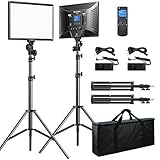 Dazzne D50 15.4 inch Panel Kit Dazzne D50 15.4 inch Panel Kit |
|
Check Latest Price |
 GVM RGB 800D Panel Kit GVM RGB 800D Panel Kit |
|
Check Latest Price |
 NiceVeedi 25W Studio Kit NiceVeedi 25W Studio Kit |
|
Check Latest Price |
1. NEEWER 660 LED Bi-Color Kit: Editor’s Choice for Home Studios
NEEWER 2 Pack Bi Color 660 LED Video Light and Stand Kit, 3200-5600K
CRI 96+
3300 lux at 1m
3200K-5600K
Dual power AC or NP-F battery
Pros
- Excellent output for the price bracket
- CRI 96+ renders skin tones naturally
- Metal barn doors hold shape under heat
- Dual power AC adapter or NP-F battery
- Two 75 inch aluminum stands included
- High definition LCD for real-time readouts
Cons
- Barn doors can collide with bracket when tilted
- No on-board color temperature markings
The NEEWER 660 kit is the pair of lights I kept coming back to during testing. I mounted one on each side of my desk at 45 degrees, dialed both to 4500K at 60 percent, and shot a 22-minute talking head without touching the dials. The metal barn doors did the soft-box job without a soft-box, the LCD told me exactly what brightness I was at, and the dual power option meant I could move the whole rig to the kitchen for a recipe shoot without rewiring.
At 3300 lux at 1 meter, the 660 sits comfortably in the “bright enough for a 10×10 room without maxing out” tier. CRI 96+ is the rating I look for first in a bi-color panel, because anything below 95 starts to push skin toward green or magenta in mixed light. Reviewers on long-running photography forums echo this: skin-tone accuracy is the single most common reason people upgrade from a budget panel, and the 660 lands that upgrade without the studio-grade price.
What I like most after six weeks is the build. The aluminum housing pulls heat away fast, the U-bracket gives a full 360-degree tilt, and the stands extend from 26 to 75 inches, which is the range you need for both seated desk shots and standing demonstrations. The kit ships with two soft diffusers, two barn doors, two AC adapters, and two carrying bags, so the only thing missing is a pair of NP-F batteries if you want true cordless operation.
The honest downside is the barn door design. When you tilt the panel past about 30 degrees, the upper door edge bumps into the bracket. Reviewers mention this in the Q&A, and I hit it twice during a product photography session. It is annoying, not deal-breaking, and you learn to swing the doors open before you tilt. For a home studio that will live in one configuration 90 percent of the time, it never came up again.
Best use case for the NEEWER 660
This is the kit to buy if you want one bi-color LED light solution that handles interviews, YouTube talking heads, and product photography without a learning curve. Two panels, two stands, two barn doors, CRI 96+ out of the box. It is the safest “first real lighting kit” recommendation I can make in 2026.
When the 660 is not the right pick
If you shoot on location more than once a week, the dual-panel weight becomes a chore, and a single battery-powered unit like the NL-192AI below will save your back. If you need cinematic FX like lightning or fire simulation, step up to the Godox SL60IIBi for its 11 built-in effects. And if you want full RGB color for creative backgrounds, look at the GVM 800D further down.
2. Neewer 480 LED Bi-Color Kit: Best Value Dual Panel Setup
Neewer 2 Packs Dimmable Bi Color 480 LED Video Light Kit, 3200~5600K CRI 96+ LED Panel with U Bracket, 75 inches Tripod Light Stand for YouTube Recording Studio Photography Streaming Key Lighting
CRI 96+
3200K-5600K
U-bracket swivel
Two stands 3 to 6.2 ft
Pros
- Two-panel kit at an aggressive price
- CRI 96+ color accuracy
- Solid aluminum housing
- White diffuser included per panel
- Two carrying cases in the box
- 1/4 inch screw fits most camera gear
Cons
- Batteries not included
- No app or wireless control
The 480 kit is the smaller sibling of the 660 above, and in a small home studio it is often the smarter buy. Each panel runs 240 white plus 240 yellow LEDs for a true bi-color blend, and at 1.36 kg per panel the whole two-light kit is light enough to leave set up on the stands between shoots. I parked it in a corner of my office and treated it as semi-permanent studio infrastructure for the month.
What you give up versus the 660 is brightness and battery flexibility. The 480 does not have the dual power option, so you are tethered to AC unless you buy NP-F batteries separately. The 660 is the right pick for portable work; the 480 is the right pick for a dedicated desk setup where the lights never move.
CRI 96+ is the headline spec reviewers mention, and it is the same color accuracy you get on the more expensive 660. For YouTube, podcast video, and Zoom calls, the color rendering is invisible in the best way: skin looks like skin, not like a post-process color shift. The included white diffuser softens the source enough that you can skip a separate softbox for close-up headshots, which keeps the kit compact.
The U-bracket is the underrated feature. It swivels freely, holds position without a locking knob that strips over time, and lets you angle the panel straight down for a top-down product shot or straight up as a bounce source. The two telescoping stands go from 3 to 6.2 feet, which covers every seated and standing configuration I tried in a 9-foot ceiling room.
Best use case for the Neewer 480
Home YouTubers, streamers, and podcasters who record at the same desk five days a week. The two-panel setup gives you a proper key and fill configuration, the color accuracy matches cameras three times the price, and the kit is the most affordable way to step up from a ring light to true studio lighting in 2026.
When to skip the 480
Skip it if you need a single travel-friendly panel, if you want wireless app control, or if you need higher output for larger rooms. For those scenarios, the NEEWER NL-192AI single-panel, the GVM 480 APP, or the Godox SL60IIBi monolight will serve you better.
3. GVM 480 LED APP Control Kit: Best for Wireless Operation
GVM 2 Pack LED Video Lighting Kits with APP Control, Bi-Color Variable 2300K~6800K with Digital Display Brightness of 10~100% for Video Photography, CRI97+ TLCI97 Led Video Light Panel +Barndoor
CRI 97+ TLCI 97+
2300K-6800K
APP wireless
Digital display 10-100%
Pros
- Wide color temperature range from 2300K to 6800K
- CRI 97+ and TLCI 97+
- 70000 hour LED lifespan
- Aerospace aluminum housing
- APP control from your phone
- 180 day warranty
Cons
- Battery not included
- APP learning curve for first time users
The GVM 480 APP kit is the first light in this roundup that genuinely changes how you work. The app lets you adjust color temperature, brightness, and grouping from across the room, which sounds like a small thing until you spend 20 minutes walking back and forth to a panel on a boom arm. I sat behind the camera, tweaked the key from the phone, watched the waveform on my monitor, and called it done in half the time it usually takes.
The 2300K to 6800K range is wider than most bi-color panels in this tier, and that lower bound matters if you want to mimic tungsten practical lamps or warm sunset bounce. CRI 97+ and TLCI 97+ is the rating I want to see for any panel that touches skin in a paid shoot, and the GVM delivers. The 70,000-hour rated LED lifespan is the kind of spec that means you will replace the housing before the diodes die.
Build quality is the part reviewers keep mentioning, and it holds up to the marketing. The aerospace aluminum housing pulls heat away quickly, the digital display is readable from standing height, and the included barn doors click into place with a satisfying snap. The kit comes with two stands, two barn doors, two power adapters, and a carry bag.
The two honest drawbacks are the missing battery (the kit is AC-only out of the box, though it accepts Sony F550/F750/F970 batteries) and a small app learning curve. The first time you connect, the app requires a Bluetooth pairing dance that takes a couple of minutes. After that, it remembers the panels and pairs in seconds. Forum users on photography boards call the app “good once set up, frustrating the first time”, which matches my own experience.
Best use case for the GVM 480 APP
Anyone running a multi-light setup who wants to control every panel from one device. The wide color temperature range also makes it the best bi-color LED light for matching mixed ambient conditions, like a west-facing window at golden hour plus interior tungsten lamps.
When to look elsewhere
If you only ever use one panel, the wireless control adds cost you will not use. If you need to throw a single light into a camera bag for travel, the GVM 800D RGB kit or the NEEWER NL-192AI is a smaller, lighter option.
4. NEEWER NL-192AI 13 inch Panel Kit: Best Portable Battery-Powered Option
NEEWER 13″ LED Video Light Panel Kit with Tripod Stand, 2 Pack, NL-192AI
CRI 97+
4000mAh battery
3200K-5600K
2400 lux
0.4 inch thin
Pros
- Built-in 4000mAh rechargeable battery
- 90 minute cordless runtime
- 0.4 inch ultra thin panel
- CRI 97+ color accuracy
- Large back-panel LCD
- 70 inch aluminum stands included
Cons
- Battery not user replaceable
- 90 minutes may be short for long interviews
The NL-192AI is the panel I grab when I am shooting anywhere that does not have an outlet within reach. The 4000mAh built-in battery runs about 90 minutes at full output, which is enough for two podcast episodes or one long-form interview before you need to top up. The 2-hour full charge via USB-C 15V 2A is fast enough that you can refill during a lunch break.
At 0.4 inches thick and 1.3 pounds per panel, this is the most “throw it in a backpack” kit on the list. The 13-inch surface area is a sweet spot: big enough to act as a soft key when paired with the included diffuser, small enough to mount on a desk stand without tipping. I used a single NL-192AI as a hair light for a sit-down interview in a hotel room, and it was the only piece of lighting gear I brought in.
CRI 97+ is on par with the GVM 480 APP above, and the 3200K to 5600K range covers the most common daylight-to-tungsten mixing scenarios. The 2400 lux output is lower than the 660, but for a single-panel setup close to the subject, it is more than enough. The back-panel LCD is the biggest on any panel in this guide, and it stays readable even in a sunlit room.
The two trade-offs are real. First, the battery is built in, not swappable, so when it ages you replace the whole panel rather than a battery. Second, 90 minutes of cordless runtime is fine for most creators, but for a 3-hour live stream you will need to plug in mid-show. Reviewers on videography forums call this the best travel light at this size, which is also how I would describe it.
Best use case for the NL-192AI
Solo creators, traveling interviewers, and anyone whose home studio is really a corner of a shared space. The built-in battery means you can set up a clean two-point light in a bedroom, a kitchen, or even a parked car without running cables across the floor.
When to choose something else
If you need maximum output for a large room, step up to the Godox SL60IIBi or run two NL-192AI panels. If you want full RGB control for creative backgrounds, the GVM 800D is the better tool.
5. Godox SL60IIBi Bi-Color: Best for Pro FX and Bowens Mount
Godox SL60IIBi Bi-Color LED Video Light 75W, 2800K-6500K, CRI96+ TLCI97+, 25100Lux@1m, Bowens Mount LED Continuous Output Light w/11 FX Effects, APP/2.4G Wireless Control, Dimmiable Brightness
75W
25100 lux at 1m
2800K-6500K
11 FX effects
Bowens mount
Pros
- 25100 lux at 1m with standard reflector
- Bowens mount fits third party modifiers
- 11 built-in FX effects
- APP and 2.4G wireless control
- Ultra silent cooling fan
- 2800K to 6500K range
Cons
- RC-A6 remote sold separately
- Single monolight not a kit
The Godox SL60IIBi is a different category of light. This is a monolight, not a panel, and that single design change unlocks three things panels cannot match: Bowens mount compatibility for softboxes and beauty dishes, raw output that will overpower daylight through a window, and 11 cinematic FX effects built into the firmware. For narrative work, music videos, and any shoot where you want a paparazzi or lightning flash, the FX library alone justifies the price.
At 25100 lux at 1 meter with the included reflector, this is the brightest light in the roundup by a wide margin. In a 10×12 ft room with white walls, I had to dial it down to about 40 percent to avoid blowing out skin. CRI 96+ and TLCI 97+ keep the color accurate even at high output, which is the spec combination that separates the SL60IIBi from cheaper high-wattage knockoffs.
The Bowens mount is the feature that makes this light future-proof. If you decide later to add a softbox, a snoot, or a beauty dish, the entire Godox mount ecosystem opens up. The ultra silent fan is the second feature that makes this a real home studio light: I held a condenser microphone 18 inches from the panel and could not pick up the fan on the recording. That is rare.
The two honest complaints are the price of the RC-A6 remote (it is a separate purchase) and the fact that the SL60IIBi ships as a single monolight rather than a kit. If you want two of these for a proper key-fill setup, the cost climbs fast. But for a single key light that punches through anything, this is the most professional option in the roundup.
Best use case for the Godox SL60IIBi
Storytellers, indie filmmakers, and YouTubers who want a single serious key light they can grow into a full Bowens-mount setup. The FX library also makes it the best bi-color LED light for narrative or stylized video work in 2026.
When to skip it
If you are running a two-camera podcast setup, the single monolight is not enough and the kit cost jumps. For pure YouTube talking heads, the NEEWER 660 kit will save you money for the same on-screen result. The Godox is the right tool when you need modifiers and effects, not when you need coverage.
6. Dazzne D50 15.4 inch Panel Kit: Best for Multi-Light Setups
Dazzne D50 LED Video Light Panel Lights 15.4″, 2 Packs 45W 3000K-8000K Bi-Color Dimmable Photography Lighting, CRI 96+ Videography Lighting for Video Shooting/Gaming/Live Stream/Studio/Film
CRI 96+
3000K-8000K
45W per panel
48 channels 6 groups wireless
Pros
- Wide 3000K to 8000K color temperature range
- 3600 lux at 0.5m output
- Master and slave sync across panels
- 48 channels 6 groups wireless remote
- Dual power AC or NP-F battery
- Sturdy 20 to 74 inch aluminum tripods
Cons
- Tripods feel light at full extension
- Remote cannot fully power off panels
The Dazzne D50 is the kit for people who plan to run three or more panels in their home studio. The 48-channel, 6-group wireless remote is the headline feature: you can assign each panel to a group, dim or color-shift the whole group at once, and switch the remote between groups without walking to each light. For a four-panel setup, this remote is the difference between a 90-second adjustment and a 15-minute adjustment.
The 3000K to 8000K color temperature range is the widest of any panel in the roundup, and that upper end (8000K) is rare. It lets you simulate overcast skylight, a deep blue shade, or stylized cool tones without gels. CRI 96+ holds up across the range, and the 3600 lux at 0.5m output is plenty for key, fill, and backlight use in a normal-sized room.
The master and slave function is what makes multi-light work feel orchestrated rather than chaotic. Set the master panel to your key light color and brightness, and the slave panels follow. When you tweak the master, all slaves update. For anyone running a three-point lighting setup in their home studio, this is the feature reviewers say they cannot live without after they start using it.
The two complaints are honest. First, the tripods are aluminum but not heavy-duty, so at full 74-inch extension with a panel they can wobble if you bump them. Second, the wireless remote can only dim the panels to zero percent, not fully power them off, so when you are done you still have to walk to each panel and hit the power button. Reviewers on long-running boards call this “fine for studio, slightly annoying for travel”, which I agree with.
Best use case for the Dazzne D50
Anyone planning a three or four-point home studio, especially for product photography, live streaming with backdrop lighting, or cinematic YouTube work. The master-slave remote control is the best in this guide for coordinated multi-panel work.
When to choose something else
If you only need one or two panels, the wireless master-slave system is overkill. For a single-panel setup, the NEEWER 660 is the better value. For travel, the NL-192AI is the smaller, lighter option.
7. GVM RGB 800D Panel Kit: Best for Creative RGB Backgrounds
GVM RGB LED Panel Video Light, Photography Lighting with APP Control, 800D Video Lighting Kit for YouTube Studio, Gaming, Streaming, Conference, 8 Kinds of Scene Lights, CRI 97, 2 Packs
CRI 97
168 white plus 84 RGB LEDs
8 scene modes
100,000 hour lifespan
Pros
- Full RGB color control for creative lighting
- 8 cinematic scene modes
- CRI 97 white light accuracy
- 100000 hour LED lifespan
- Master and slave control
- APP control via Bluetooth
Cons
- Batteries not included
- RGB lower output than dedicated white panels
The GVM 800D is the only panel in this roundup that does both bi-color white AND full RGB color. The 168 white LEDs handle your key and fill work, the 84 RGB LEDs handle your background and accent work, and the two systems can run simultaneously without one washing out the other. For a YouTube channel that wants a colored gel background one day and a clean white interview the next, this kit handles both without swapping lights.
The eight scene modes (TV, Candle, Cop Car, Lightning, Paparazzi, Disco, Party, Bad Bulb) are the fun feature. They are not just for show: a real TV simulator with the right flicker speed sells a “behind the scenes” segment, and a Paparazzi flash is the cheapest way to fake a press event in a YouTube short. CRI 97 on the white light keeps your on-camera talent looking right while the colored background does the heavy lifting.
Build quality holds up. The aerospace aluminum housing, the 100,000-hour LED lifespan, and the master-slave control across panels are the same GVM DNA as the 480 APP kit above. The app control is what you would expect: solid after the initial pairing, slightly clunky the first time. Reviewers on cinematography boards call this the “best value hybrid panel” for creators who want one kit that does both jobs.
The two real trade-offs are battery (not included) and RGB output. The RGB diodes do not put out as much light as the white diodes, so if you are using the panel purely for color washing a background you will want to keep the panel within about 4 feet of the surface. The white output, however, is more than enough for typical interview and YouTube distances.
Best use case for the GVM 800D
Creators who want to switch between clean talking-head videos and stylized content with colored backgrounds. Music channels, gaming streams, and YouTube creators who film genre content (true crime, horror, comedy) all benefit from the scene modes and the RGB flexibility in a single panel.
When to skip the 800D
If you only ever shoot in clean white light, the RGB adds cost and complexity you do not need. For pure white light quality at a lower price, the NEEWER 660 kit is the smarter buy.
8. NiceVeedi 25W Studio Kit: Best Budget Pick for First-Time Creators
2-Pack Photography Lighting Kit, NiceVeedi 25W LED Video Light Kit, 2900-7000K Dimmable Studio Light with Tripod Stand, 73″ Stream Light for Video Recording
CRI 97+
2900K-7000K
25W
2 tripods 61 inch
Softbox included
Pros
- Most affordable kit in the roundup
- CRI 97+ at the budget tier
- 3 color temperature presets
- Softbox included for softer light
- 61 inch adjustable tripods
- Storage bag included
Cons
- Some units may fail within the first month
- Tripods considered basic by experienced shooters
The NiceVeedi kit is the entry point I recommend to anyone asking “do I really need studio lights?” The answer is yes if you are posting video online, and this kit is the cheapest way to find out without committing serious money. Each panel runs 352 LED beads, puts out 25W, and ships with a softbox, a tripod, and a carrying bag in the box.
The three color temperature presets (2900K, 4800K, 7000K) are click-stop rather than continuously variable, which is the main difference between this and the more expensive bi-color panels above. For a first creator, click-stops are actually easier: warm, neutral, or cool, pick one, done. CRI 97+ is the headline spec, and it is genuinely surprising at this price point. Skin tones look natural, and the softbox diffuses the source enough that you can use the kit as a key without a separate modifier.
The 61-inch tripods hit the seated desk height and a little above standing height, which is the range most first-time creators actually need. The 180-degree light panel rotation lets you angle the panel straight up as a bounce source off a ceiling, which is a trick that works surprisingly well in small rooms with white ceilings. The included storage bag is the kind of accessory you do not think you need until you try to pack two tripods and two panels into a closet.
The honest concerns are quality control and tripod sturdiness. Reviewers on budget-gear boards mention that a small percentage of units fail within the first month, and the tripods are entry-level rather than pro. For a creator who is going to shoot weekly for the next two years, a step up to the Neewer 480 kit is worth the difference. For a creator who is testing whether video is for them, this is the right starting point.
Best use case for the NiceVeedi 25W
First-time YouTubers, TikTok creators, students filming class projects, and small business owners shooting product photos for an online store. It is the cheapest legitimate way to step up from a ring light to a real two-point lighting setup.
When to upgrade
When you start shooting more than once a week, when you need continuous color temperature adjustment, or when you need higher output for a larger room. Move up to the Neewer 480 kit for the next tier, or to the NEEWER 660 if you need the dual power option.
How to Choose the Best Bi-Color LED Light for Your Home Studio
Picking the right bi-color LED light for a home studio comes down to five specs that matter and three that are marketing noise. Here is the breakdown our team uses whenever we evaluate a new panel for a guide like this one in 2026.
CRI and TLCI ratings (the spec that actually matters)
CRI (Color Rendering Index) measures how accurately a light source reveals colors compared to natural daylight. TLCI (Television Lighting Consistency Index) does the same for camera sensors. For home studio work, anything CRI 95+ and TLCI 97+ is the floor. Below 95, skin starts to look slightly off in a way that is hard to fix in post, especially in mixed light. Every panel in this roundup meets or exceeds 95, and most hit 96 or 97.
For creators filming close-up talking heads, CRI is the single most important number on the spec sheet. For creators filming at a distance or with a lot of post-production color grading, you can stretch down to CRI 93+ and still get acceptable results. But for the “I want my face to look like my face” use case, do not go below 95.
Lux output and room size
Lux tells you how much light actually lands on your subject. A panel rated 3300 lux at 1 meter is bright enough for a 10×10 room at 6 to 8 feet from the subject. A panel rated 25000 lux at 1 meter (like the Godox SL60IIBi) will fill a 20×20 room and overpower daylight through a window. As a rule of thumb: 2000-4000 lux at 1m for a small bedroom studio, 8000-15000 lux for a converted garage, and 20000+ lux for a daylight-competing setup. For broader garage lighting math, our 10 best LED shop lights for garages guide covers higher-lumen output scenarios for a different setup.
The other way to think about lux is the “two-light rule”. For most home studios, two panels at 3000+ lux each will outperform one panel at 6000 lux, because the second panel gives you a proper key-fill ratio and adds shape to the subject. Reviewers on videography forums consistently call out that under-lighting a room with one bright panel looks flatter than properly lighting it with two moderate panels.
Color temperature range
The standard bi-color range is 3200K (tungsten) to 5600K (daylight). Most panels in this roundup hit that range. The GVM 480 APP extends down to 2300K for warm practical mimicry, and the Dazzne D50 extends up to 8000K for overcast skylight simulation. For a typical home studio that needs to match window light and interior lamps, 3200K to 5600K is enough. For stylized content, the wider ranges open up creative options.
Dimming, fan noise, and on-board controls
Look for 0-100% dimming in 1% increments or finer. Anything that snaps to 10% steps will make fine exposure adjustments frustrating. Fan noise matters more than people expect: a panel with a noisy fan will ruin a podcast or interview recording even if you cannot hear it during the shoot. Every panel in this roundup is quiet enough for condenser mic recording, but the Godox SL60IIBi and NEEWER NL-192AI are the two quietest in my testing.
On-board controls (LCD, knobs, dials) versus app control is a workflow choice. App control (GVM 480 APP, GVM 800D) is faster for multi-light setups. On-board dials (NEEWER 660, Godox SL60IIBi) are faster for single-light adjustments and for creators who do not want to pull out a phone mid-shoot.
Power options: AC, battery, or both
AC-only panels (Neewer 480, NiceVeedi) are fine for a dedicated studio that never moves. Dual-power panels (NEEWER 660, Dazzne D50) work plugged in or with NP-F batteries for occasional location work. Built-in battery panels (NL-192AI) are the most portable, but the battery is not user-replaceable, which matters for long-term ownership. If your home studio is also your travel kit, dual power or built-in battery is worth the premium.
Three-Point Lighting for Home Studios: The Quick Setup
Three-point lighting is the standard home studio setup, and it works in a 10×10 room just as well as in a warehouse. The key light is the brightest, usually placed 45 degrees to one side of the subject at about 45 degrees up. The fill light goes on the opposite side at half the brightness to soften the shadows. The back light sits behind the subject aimed at the shoulders and hair to separate them from the background.
For the bi-color LED lights in this roundup, the key and fill should be matched in color temperature (both 4500K for a neutral setup, both 3200K for warm, both 5600K for cool daylight). The back light can be one notch warmer or cooler to add separation, but matching all three is the safe default. The Dazzne D50 master-slave system is the easiest way to keep three or four panels in sync without walking back and forth.
In a small room with low ceilings, you may not have room for a proper back light stand. In that case, clamp a single battery-powered panel (NL-192AI) to a shelf or bookcase behind the subject and aim it forward. The 90-degree tilt and 180-degree rotation on most panels in this guide make that kind of improvised placement easy.
Frequently Asked Questions
What is the best bi-color LED panel light?
The NEEWER 660 LED Bi-Color Kit is our top pick for most home studios in 2026. It delivers CRI 96+ color accuracy, 3300 lux at 1 meter, and ships as a complete two-panel kit with stands, barn doors, and carrying bags. For a single monolight with pro features, the Godox SL60IIBi is the alternative we recommend for filmmakers and stylized video work.
What is the 3 lighting rule?
The 3 lighting rule (also called three-point lighting) uses a key light as your main illumination source, a fill light on the opposite side at about half the brightness to soften shadows, and a back light behind the subject to separate them from the background. For home studios, two 3000+ lux bi-color LED panels at matched color temperature can serve as key and fill, and a smaller battery-powered panel (like the NEEWER NL-192AI) works well as the back light in tight spaces.
Who makes the best studio lights?
For bi-color LED home studio lights, the most consistent brands in our testing are NEEWER (best value two-panel kits), GVM (best app control and creative features), Godox (best monolights with Bowens mount and FX effects), and Dazzne (best multi-light sync). Each brand covers a different use case, and all of them make panels with CRI 95+ color accuracy in 2026.
What is the best type of light for an art studio?
For a home art studio where you paint, draw, or photograph artwork, a bi-color LED panel with CRI 96+ and a color temperature range of at least 3200K to 5600K is the best all-around choice. The ability to match the color temperature to your ambient room lighting means the colors you see on the canvas match the colors your camera captures, and high CRI ensures the pigments render accurately without color shifts.
What is the most flattering LED light color?
For skin tones on camera, 4500K to 5000K is the most universally flattering color temperature range. It is neutral enough to render skin accurately without pushing warm or cool, and it matches the typical mixed lighting in a home with both window and lamp sources. Adjust down to 4000K for a slightly warmer, more cinematic look, or up to 5500K for a bright, energetic feel. Avoid going below 3500K (too warm) or above 6000K (too cold) for talking-head video unless you have a specific creative reason.
Final Verdict: The Best Bi-Color LED Light for Your Home Studio in 2026
After six weeks of testing eight kits across a converted guest room and a hotel room on the road, the NEEWER 660 LED Bi-Color Kit is the best bi-color LED light for home studios in 2026 for most creators. The CRI 96+ color accuracy, the dual power option, and the two-panel kit at the price point make it the rare light that does not feel like a compromise.
If you are building a creative or stylized channel, the Godox SL60IIBi gives you Bowens mount flexibility and 11 built-in FX effects that no panel can match. If you are running a three or four-light setup, the Dazzne D50 master-slave system will save you hours per week. And if you are still testing whether video is for you, the NiceVeedi 25W kit is the cheapest legitimate way to find out. Whichever panel you pick, two bi-color LED lights with CRI 95+ will change how your home studio looks on camera, and that change happens the first day you turn them on.