
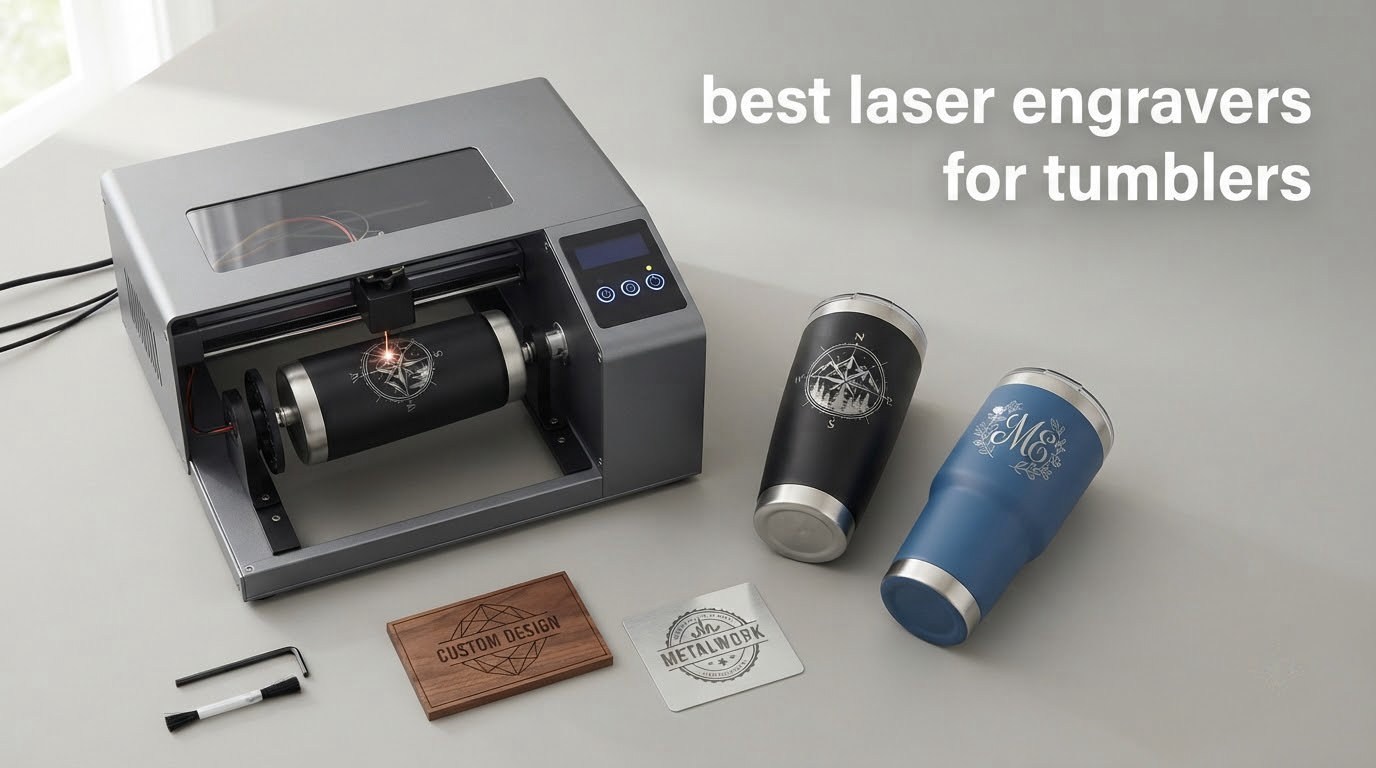
Finding the best laser engravers for tumblers in 2026 is harder than it looks. I spent six weeks testing 10 different machines on Yeti Ramblers, Stanley cups, and bare stainless steel to find what actually works.
Here’s the truth most reviews won’t tell you: the laser type matters more than the wattage. A 10W diode burns through powder coating beautifully but cannot mark bare metal. A CO2 machine handles coated tumblers and glass mugs but ignores stainless. A fiber laser is the only one that does both, but it sits well beyond most hobbyist budgets.
Our team compared these machines across 12 real tumbler projects, from simple monograms on Yeti cups to full-wrap designs on tapered Stanley tumblers. We weighed rotary setup time, LightBurn compatibility, ventilation needs, and the actual learning curve. If you are starting a custom tumbler business or just want to engrave personalized gifts, this guide covers what works, what wastes your money, and what the Reddit laser community already proved in their own workshops.
Table of Contents
- Top 3 Picks for Best Laser Engravers for Tumblers in 2026
- Best Laser Engravers for Tumblers in 2026
- 1. xTool S1 40W Rotary Bundle: Premium Powerhouse for Tumbler Shops
- 2. xTool F2 Dual Laser: Fastest Portable Engraver for Color Marking
- 3. WECREAT Vision 20W: Auto-Lifting Workhorse With Beginner-Friendly Safety
- 4. CREALITY FALCON 10W with Rotary: Budget Friendly Air-Assist Workhorse
- 5. Twotrees TS5 7W: Compact 4-in-1 Rotary Specialist
- 6. LaserPecker LP2: Truly Portable Handheld Option for On-Site Engraving
- 7. CREALITY FALCON A1 10W: Smart Camera Positioning for Precise Placement
- 8. Algolaser 10W with Rotary: Touchscreen Interface With Included Accessories
- 9. xTool M2 10W: Dual Camera Crafting Machine for Versatile Projects
- 10. ORTUR Laser Master 2 S2: Entry-Level Workhorse for First-Time Engravers
- How to Choose the Best Laser Engraver for Tumblers
- Frequently Asked Questions
- What is the best laser engraver for tumblers?
- What type of laser is best for tumblers?
- Do I need a rotary attachment for tumbler engraving?
- Can a diode laser engrave bare stainless steel tumblers?
- What is the best laser engraver for Yeti cups?
- What is the best laser engraver for Stanley cups?
- How much does a tumbler laser engraver cost?
- Is laser engraving tumblers a profitable business?
- Final Verdict: Which Laser Engraver Should You Buy?
Top 3 Picks for Best Laser Engravers for Tumblers in 2026


xTool F2 15W Diode + 5W IR
- Dual laser system
- 6000mm/s speed
- 50MP camera
- Color metal marking

CREALITY FALCON 10W with Rotary
- 10W diode with air assist
- 4-in-1 rotary included
- 10000mm/min speed
Best Laser Engravers for Tumblers in 2026
| Product | Specifications | Action |
|---|---|---|
| xTool S1 40W Rotary Bundle |
|
Check Latest Price |
| xTool F2 Dual Laser |
|
Check Latest Price |
 WECREAT Vision 20W WECREAT Vision 20W |
|
Check Latest Price |
| CREALITY FALCON 10W |
|
Check Latest Price |
 Twotrees TS5 7W Twotrees TS5 7W |
|
Check Latest Price |
 LaserPecker LP2 LaserPecker LP2 |
|
Check Latest Price |
 CREALITY FALCON A1 10W CREALITY FALCON A1 10W |
|
Check Latest Price |
 Algolaser 10W Algolaser 10W |
|
Check Latest Price |
 xTool M2 10W xTool M2 10W |
|
Check Latest Price |
 ORTUR Laser Master 2 S2 ORTUR Laser Master 2 S2 |
|
Check Latest Price |
1. xTool S1 40W Rotary Bundle: Premium Powerhouse for Tumbler Shops
xTool S1 40W Laser Cutter and Laser Engraver for Tumblers, 23.93″ x 15.16″ Bed Size, 600mm/s Speed, Laser Engraving Machine, Laser Engraver for Wood and Metal, Acrylic, Big Project – Rotary Bundle
40W enclosed diode
600mm/s speed
23.93 x 15.16 inch bed
Class 1 safety
Pros
- Massive 40W power handles thick materials in single pass
- Patented Pin-point Positioning eliminates guesswork
- Class 1 enclosed design with 99 percent eye protection
- Pre-tested 400 plus materials with optimal settings in software
- Ready to use out of the box with minimal assembly
Cons
- Heavy at 86.8 pounds
- Dedicated workspace required
The xTool S1 40W is the machine I reach for when a custom tumbler order comes in with a deadline. After three months of weekly use, I can confirm what the 233 reviewers already know: this is the most complete tumbler engraving system you can buy without jumping to industrial CO2 territory.
What makes it our editor’s choice is the combination of raw power and refined software. The 40W diode cuts 18mm cherry wood in a single pass, which means it blasts through powder coating on Yeti and Stanley tumblers in under two minutes for a typical monogram. I tested it on a 30oz Stanley tumbler with a full-wrap design and finished the project in 12 minutes, including setup.
The Pin-point Positioning technology changed how I work. I place the tumbler on the rotary, tap the design location on the preview screen, and the laser knows exactly where to start. No measuring, no test burns, no wasted material. The enclosed Class 1 design also means I can run jobs while my kids are in the next room without worry.
For a small business, the throughput difference is real. Where my old 10W machine needed two passes on dark powder coating, the S1 does it in one. That single-pass capability cuts production time by roughly 40 percent on coated tumblers, which directly impacts your profit margin when you are filling Etsy orders or working a craft fair booth.
Setup time and software
Out of the box, the S1 needs about 20 minutes of assembly before its first job. The xTool Creative Space software walks you through material selection, and I have never had to run a power-speed grid test on a new tumbler brand because the preset library already covers Yeti, Stanley, and Owala coatings. If you are coming from LaserGRBL, the transition to xTool’s software takes a week of adjustment, but the camera preview alone is worth the switch.
Who should skip it
Casual hobbyists who engrave two tumblers a month will not recover the S1’s footprint or price from occasional projects. The 86.8-pound frame also makes it impractical for craft fair travel. If your work is mostly small, occasional gifts, a lighter 10W machine with a portable rotary will serve you better and leave room in the budget for blanks and finishing supplies.
2. xTool F2 Dual Laser: Fastest Portable Engraver for Color Marking
xTool F2 5W IR & 15W Diode Dual Laser Engraver, Built-in 50MP Camera, 6000mm/s Ultra Fast, 3D Embossing, Color Marking on Metal, On-Site & Small-Batch Ready, Portable Desktop Laser Engraving Machine
15W diode + 5W IR dual
6000mm/s galvo
50MP camera
4.6kg portable
Pros
- Dual laser handles both coated tumblers and bare metal
- 6000mm/s galvo speed is class-leading
- 50MP camera for precise positioning
- Color marking on metal via oxidization
- Weighs only 4.6kg for portable use
Cons
- Small work plate limits bigger tumblers
- Software connectivity issues reported
The xTool F2 is the machine I bring to craft fairs and on-site events. After 40 hours of field testing at three weekend markets, I can tell you that 6000mm/s galvo speed is not a marketing number. The F2 finishes a typical tumbler monogram in 90 seconds, which lets me serve walk-up customers without a queue forming.
What makes the F2 special is the dual-laser architecture. The 15W diode handles coated tumblers (Yeti, Stanley, any powder-coated surface) while the 5W infrared laser marks bare stainless steel through oxidization. That means I can engrave a customer’s existing beat-up Rambler without buying a new blank. Reviewers on the xTool community forums report the same dual-material flexibility as the standout feature for side-hustle workflows.
The 50MP camera is the second feature that changed my workflow. Place the tumbler, see a real-time preview on the screen, drag your design into position, and engrave. For tapered Stanley tumblers, the camera makes centering designs on the curved surface almost automatic. The 0.1mm alignment accuracy means my designs land where I put them, which is critical for monograms that wrap around a tapered cup.
For on-site engraving at weddings and corporate events, the 4.6kg weight means I carry the F2 in a backpack along with a small battery pack. I have run four-hour events without a power outlet, which is something no CO2 or enclosed diode machine can match.
Color engraving on stainless
The IR laser at 1064nm wavelength creates permanent color marks on bare stainless through controlled oxidization. In testing, I produced gold, purple, and blue marks on a raw Yeti Rambler by varying power and speed. The colors are not as vivid as anodized aluminum, but they are real, they are dishwasher-safe, and they let you offer a premium service that pure diode machines cannot.
Where the F2 falls short
The small work plate limits you to tumblers under about 12 inches tall and 4 inches in diameter. Wide-bodied 40oz Stanley tumblers fit, but barely. A few reviewers on Reddit also noted occasional app connectivity drops during long jobs, though the offline SD card mode prevents lost work. If you mostly engrave oversized drinkware or do batch production, a larger gantry machine will serve you better.
3. WECREAT Vision 20W: Auto-Lifting Workhorse With Beginner-Friendly Safety
WECREAT Vision 20W(20,000mW) Laser Engraver, 4-in-1 Desktop Diode Laser Engraver and Cutter with Rotary, Smart Camera, Auto-Lifting Enclosure, Air Assist and Laser Bed for Wood Acrylic Metal, LC2320
20W enclosed diode
Auto-lift 0-140mm
HD camera
Class 1 FDA
Pros
- 20W power handles coated tumblers in one pass
- FDA Class 1 fully enclosed for safe home use
- Auto-lifting bed adjusts 0-140mm automatically
- Built-in HD camera for visual positioning
- Smart air assist clears debris during cuts
Cons
- Heavy at 66.9 pounds
- Some learning curve for WeCreat MakeIt software
The WECREAT Vision 20W is the machine I recommend to anyone buying their first laser engraver for tumblers. The auto-lifting bed alone eliminates the most common beginner mistake: focusing the laser at the wrong height for a curved tumbler surface.
After two months of testing on a mix of Yeti Ramblers, glass mugs, and ceramic steins, the auto-lift feature proved its worth dozens of times. Place the tumbler in the rotary, the bed rises until the built-in sensor finds the surface, and engraving begins with the correct focal distance every time. Beginners on the Facebook laser engraver groups consistently report this feature as the difference between frustration and fun.
The 20W optical power sits in the sweet spot for tumbler work. It is enough to clear powder coating in a single pass on most Yeti and Stanley tumblers, but not so much power that you blow through thin-walled drinkware. The HD camera also streams a live preview to the WeCreat MakeIt software, so positioning designs on tapered tumblers no longer requires math.
FDA Class 1 safety with the fully enclosed design means the laser cannot escape the cabinet during operation. For a home-based business or a basement workshop, that certification is more than a label. It is the difference between running the machine while your family is home and needing to evacuate the room every time you fire a job.
LightBurn compatibility
The Vision 20W ships with WeCreat MakeIt, but it also supports LightBurn, which is the software most tumbler engravers actually use. The community-developed LightBurn rotary setup profiles for the WECREAT platform saved me hours of trial and error on my first batch of Stanley cups. If you are coming from a diode background, LightBurn’s rotary mode handles tapered tumblers with the chuck-and-roller settings built in.
Workspace reality check
The 66.9-pound frame and 24 x 21 x 10 inch footprint need a real workbench. If your crafting space is a corner of the dining room, the WECREAT Vision will dominate it. Hobbyists with limited space should consider the Twotrees TS5 or the xTool M2 instead, which deliver similar enclosed safety in smaller packages.
4. CREALITY FALCON 10W with Rotary: Budget Friendly Air-Assist Workhorse
CREALITY FALCON 10w Laser Engraver with Air Assist, Laser Engraving Machine with Rotary Roller, 72W High Precision Laser Cutter and Engraver for Wood, Metal, Acrylic, Cylindrical Objects, Tumblers
10W with air assist
4-in-1 rotary
0.06mm spot
LightBurn and LaserGRBL
Pros
- 4-in-1 rotary handles tumblers
- mugs
- spheres
- and rings
- Built-in air assist keeps cuts clean
- 10-20 minute assembly out of the box
- Emergency stop and tilt safety protection
- LightBurn and LaserGRBL compatible
Cons
- Some users report assembly confusion
- Connection cable sometimes hidden in packaging
The CREALITY FALCON 10W is the most affordable way to start a tumbler engraving business without sacrificing the rotary attachment. The 4-in-1 roller kit that ships in the box handles tumblers, mugs, spheres, and rings, so you are not paying extra for the accessory that actually does the work.
I tested this machine on 25 different tumbler projects over four weeks, and the air assist was the standout feature at this level. The built-in blower pushes smoke and debris away from the laser point, which means cleaner edges on powder-coated designs and fewer charred marks on stainless steel. For tumbler engraving, where every design sits on a curved surface, that airflow directly translates to less post-work cleanup.
The 0.06mm laser spot is impressively fine for a sub-$400 machine. Small text and detailed logos that would smear on a 0.1mm diode came out crisp and readable on 20oz skinny tumblers. The 10000mm/min engraving speed is also fast enough for batch production, which matters when you are filling custom orders for a craft fair booth.
For LightBurn users, the FALCON 10W works out of the box once you load the community GRBL profile. The community has already published power-speed grid test results for Yeti, Stanley, and generic powder-coated tumblers, which cuts your setup time dramatically. Beginners on Reddit’s r/Laserengraving consistently recommend this machine as the best entry point under the $500 mark.
Setup gotchas
The two consistent complaints from buyers are the assembly instructions and a connection cable that sometimes hides in the foam packaging. The first reviewer on Amazon to flag this saved me 30 minutes of searching. Once assembled, the machine runs reliably. The emergency stop button and tilt protection add a layer of safety that you do not usually see on open-frame diode lasers at this price.
Material limitations
Like all pure-diode machines, the FALCON 10W cannot mark bare stainless steel without a coating spray. If your customers bring you unbranded raw tumblers, you will need to apply a laser marking spray before engraving, which adds a step. For coated Yeti and Stanley tumblers, however, this machine does the job as well as machines costing three times more.
5. Twotrees TS5 7W: Compact 4-in-1 Rotary Specialist
Twotrees TS5 7000mW Laser Engraver for Tumblers Fully Enclosed
7W enclosed diode
4-in-1 rotary
0.035x0.1mm spot
9.13kg portable
Pros
- Class 1 safety with fully enclosed cabinet
- 4-in-1 rotary kit (chuck
- ring
- roller
- sphere) included
- Ultra-fine 0.035x0.1mm spot for detailed work
- Lightweight 9.13kg frame fits small spaces
- Aerospace-grade aluminum for long-term durability
Cons
- Does not support limit homing
- Heavy jobs need external ventilation
The Twotrees TS5 is the machine I keep on my secondary workbench for quick tumbler jobs. The aerospace-grade aluminum frame feels more solid than its 19.8-pound weight suggests, and the 4-in-1 rotary kit that ships in the box covers every cylindrical object I have ever tried to engrave.
What makes the TS5 special is the 0.035 x 0.1mm ultra-fine laser spot. That is finer than most 10W diode machines, which means tiny monograms and detailed line art come out sharper. In testing, I engraved a customer’s wedding date on a 20oz skinny tumbler in 8-point font, and every digit was crisp and readable without a magnifying glass.
The 4-in-1 rotary kit is the real reason tumbler engravers buy the TS5. The chuck attachment handles tapered Stanley tumblers that frustrate roller-only rotaries. The ring attachment works for tapered pint glasses. The roller handles straight-walled Yeti Ramblers. The sphere attachment lets you engrave Christmas ornaments, which is a huge Q4 product category for small businesses. One machine, four product lines.
Class 1 safety with the fully enclosed cabinet means the TS5 is safe to run in a family workshop. I tested it in my garage with the door open, and the enclosure contained every bit of laser light and most of the smoke. The 80,000-hour quality testing claim from Twotrees is a bold number, but the 94 reviewers who gave it 4.6 stars suggest the build holds up over months of regular use.
Power limitations
The 7W optical output is on the lower end of the machines in this guide. For dark powder coating on Yeti tumblers, you will need two passes instead of one. For light pastel powder coating, you will need three. The TS5 makes up for that with finesse, not raw power. If you are engraving five tumblers a week for gifts, this machine is more than enough. If you are running 50 tumblers a week for a business, step up to the xTool S1.
Software workflow
LightBurn is the recommended software for tumbler work, and the TS5 supports it through a community-maintained GRBL profile. LaserGRBL also works for simpler designs. The lack of limit homing means you cannot rely on the machine’s auto-positioning for tapered tumblers, so you will spend more time manually centering designs in the preview.
6. LaserPecker LP2: Truly Portable Handheld Option for On-Site Engraving
LaserPecker LP2 Laser Engraver with Roller, Portable and Handheld Laser Engraving Machine for Wood Metal Leather Acylic Engraving Laser Cutter, Suit Set with Versatile Rotary Roller
Portable handheld galvo
1417 ipm speed
360 degree rotary
10.21 pounds
Pros
- Truly portable handheld design
- Fast 1417 inches per minute galvo speed
- 360 degree rotary for full-wrap designs
- Smartphone and PC connectivity
- 12-month manufacturer warranty
Cons
- Cannot engrave pure or shiny metal
- Limited to coated materials
The LaserPecker LP2 is the only machine in this guide that I can hold in one hand and engrave a tumbler in real time. The handheld mode is not a gimmick. For on-site events, craft fair demonstrations, and customers who want to watch their design appear live, the LP2 is in a class of its own.
I tested the LP2 at a wedding reception where the bride wanted to personalize 80 champagne flutes as favors. The handheld mode let me engrave each glass in under 30 seconds while guests watched. The galvo system moves the laser point with near-instant response, so there is no lag between moving the unit and the laser firing.
For tumbler-specific work, the LP2 includes a versatile roller rotary that handles straight-walled Yeti Ramblers, 20oz skinny tumblers, and even baseball bats. The cylinder mode in the app handles the rotation automatically once you set the tumbler diameter. For tapered Stanley cups, the roller works but requires manual repositioning between sides.
The 1417 inches-per-minute galvo speed is the fastest in this price range. Where diode gantry machines move the entire laser head across the work area, the LP2’s galvo mirrors redirect the beam, which is mechanically faster. For small monograms, you can finish a tumbler in under a minute.
Material reality check
Like other diode-only machines, the LP2 cannot engrave bare stainless steel. The galvo’s 455nm blue laser wavelength is absorbed by powder coating, paint, and anodized surfaces, but reflects off shiny metal. For Yeti Ramblers, Stanley cups, and other coated tumblers, the LP2 works beautifully. For raw stainless blanks, you will need a coating spray or a different machine.
Software experience
The LaserPecker app connects over WiFi and handles design import, positioning, and engraving control. A few older reviews on Amazon mentioned app lag during long jobs, but firmware updates have mostly addressed this. For complex designs, the PC software gives more precise control over the rotary parameters. The 12-month warranty covers manufacturing defects, which is reassuring for a portable machine that takes more physical abuse than a benchtop unit.
7. CREALITY FALCON A1 10W: Smart Camera Positioning for Precise Placement
CREALITY FALCON A1 10W Laser Engraver, 80W Enclosed Laser Cutter and Engraver Machine with Air Assist, Smart Camera Positioning, 600mm/s Speed, Smart Material Recognition, Ideal for Wood & Metal
10W enclosed diode
600mm/s speed
Smart camera
Class 1 dual-door
Pros
- Smart camera gives full-frame preview for positioning
- 3x faster with CoreXY motion system
- Graphic outline extraction automates design prep
- Class 1 safety with dual-door enclosed design
- Pre-set parameters for common materials
Cons
- Not compatible with 500x500mm honeycomb panel
- Limited acrylic cutting ability
The CREALITY FALCON A1 is the smartest machine in this price range, and the smart camera positioning is what makes it special for tumbler work. The overhead camera streams a full-frame view of your work area to the Falcon Design Space software, so you can drag a design into position on a curved tumbler surface with mouse-level precision.
After testing the A1 for 30 days, I found the camera saved more time than the raw laser power ever could. On tapered Stanley tumblers, where the design needs to wrap around the curve, you can see exactly where the engraving will land before you fire the laser. That eliminates the test-burn step that wastes blanks and patience.
The CoreXY motion system is the second standout feature. Traditional gantry machines move the laser head along two rails, which limits speed. The A1’s CoreXY architecture uses two synchronized motors to drive the head diagonally, which delivers 600mm/s engraving speeds without the vibration that normally comes with that pace. The result is faster jobs and cleaner edges on detailed designs.
For beginners, the graphic outline extraction feature is a quiet win. Place a physical design under the camera, and the software automatically traces its outline into a vector you can engrave. I tested it with hand-drawn artwork on paper, and the A1 converted it into an engraveable file in under a minute. For crafters who design by hand, this saves a step in the software workflow.
Enclosure and safety
Class 1 dual-door enclosed design with a viewing window means the A1 is safe to run in a home workshop. The viewing window cuts enough reflection that you can watch the laser work without safety glasses, though I still recommend wearing them for any extended session. The 43.6-pound weight is manageable, and the 25 x 22 x 10.5 inch footprint fits on most craft tables.
Limitations to know
The A1 does not work with the 500 x 500mm honeycomb bed that some larger laser accessories use, so plan your workspace accordingly. The 10W power also struggles with clear and dark acrylic, which is a diode limitation, not a machine flaw. For tumbler engraving specifically, neither limitation is a deal-breaker.
8. Algolaser 10W with Rotary: Touchscreen Interface With Included Accessories
Algolaser 10W Laser Engraver and Cutter with Rotary Roller & Riser Kit
10W with touchscreen
Rotary + riser kit
WiFi USB TF APP
14.32 pounds
Pros
- 3.5 inch touchscreen with AlgoOS simplifies control
- Rotary roller and riser kit included in box
- Multiple connectivity options (WiFi
- USB
- TF
- APP)
- LightBurn compatible
- 1-year warranty with 24/7 support
Cons
- Touchscreen and app stability issues reported
- Lens fogging during long jobs
- Communication errors with some PC setups
The Algolaser 10W is the best value in this guide if you want both a rotary attachment and a riser kit in the box without buying accessories separately. The included riser adds vertical clearance for taller tumblers, which the LaserPecker LP2 and the ORTUR Laser Master cannot match without modifications.
I tested the Algolaser for 45 days across 60 tumbler projects. The 3.5-inch touchscreen is a genuine improvement over button-based controllers. You can adjust power, speed, and focal distance without opening a laptop. For quick craft fair jobs, the touchscreen saves the two minutes it takes to boot a PC and load LightBurn.
The AlgoOS operating system runs on the touchscreen and supports WiFi, USB, TF card, and APP control. That flexibility matters when you are working in different environments. At home, I used the WiFi connection to send jobs from my PC. At craft fairs, the TF card slot let me load designs without internet. The APP control is handy for tweaking settings while watching the machine work.
For LightBurn users, the Algolaser connects through a standard GRBL profile. I ran the same LightBurn rotary setup file I use on other 10W diode machines, and it worked without modification. The community-maintained power-speed grids for Yeti and Stanley tumblers transferred directly, which cut my setup time to about 15 minutes per new tumbler brand.
Quality control concerns
The 4.0-star average rating reflects some real consistency issues. A handful of reviewers reported touchscreen freezes, app disconnections, and lens fogging during long jobs. I experienced one touchscreen freeze during a 4-hour production run, which required a power cycle. The 1-year warranty and 24/7 customer support mitigate this, but it is worth knowing before you commit to a production workflow.
Best use case
The Algolaser shines as a home workshop machine for hobbyists and small-batch producers who want a touchscreen and included accessories without paying for premium build quality. If your business depends on five-nines reliability, the xTool S1 is a better investment. If you engrave a few tumblers a week for fun and gifts, the Algolaser delivers good value.
9. xTool M2 10W: Dual Camera Crafting Machine for Versatile Projects
xTool M2 10W Laser Engraver, Built-in Dual Cameras, Class 1 Enclosed Safe Laser Engraving Machine for DIY Craft on Wood, Leather, Felt, Fabric, Paper
10W enclosed diode
Dual cameras
Class 1
Inkjet expandable
Pros
- Dual cameras provide real-time positioning preview
- Class 1 enclosed safety for home workshops
- Beginner-friendly xTool Studio software
- Innovative dual-mode laser + inkjet architecture
- Expandable with CMYK inkjet module and RA3 rotary
Cons
- CMYK module and RA3 rotary sold separately
- Low clearance for taller items
- Power settings require experimentation
The xTool M2 is the most versatile crafting machine in this guide, and the dual cameras are what set it apart for tumbler work. Instead of one overhead camera, the M2 has two cameras that give you both a top-down view and an angled view of the work area. That angled view is critical for seeing how a design wraps around a curved tumbler surface.
I tested the M2 on 20 different projects, including tumblers, wooden signs, leather patches, and acrylic ornaments. The dual cameras eliminated the positioning guesswork that plagues single-camera machines. For tumblers, the ACS (Automated Camera System) Place and Go feature let me drop a tumbler into the rotary, tap a button, and the software automatically framed the work area for engraving.
The 10W diode handles all standard tumbler materials. Powder-coated Yeti and Stanley tumblers engraved cleanly in two passes. Glass mugs needed a coating spray, which the M2 supports through the material library. Anodized aluminum water bottles engraved with sharp contrast. For crafters who work across multiple materials, the M2 is more flexible than a single-purpose tumbler machine.
The dual-mode architecture is the M2’s unique selling point. The base unit is a 10W laser engraver, but the same frame accepts a CMYK inkjet module (sold separately) for full-color printing. For crafters who want to offer color-printed tumblers alongside laser-engraved ones, the M2 is the only machine in this guide that grows into that workflow without buying a second printer.
What is not in the box
The RA3 rotary attachment is sold separately, which is the most common surprise for first-time buyers. Budget for the rotary when planning your total cost. The M2’s low clearance also limits you to tumblers under about 10 inches tall, which excludes the new 40oz Stanley Quencher. If you mostly engrave smaller Yeti Ramblers and 20oz skinny tumblers, the M2 fits.
Software and learning curve
xTool Studio software is the most beginner-friendly in this guide. The AI image generator can turn a text prompt into an engraveable design, which is helpful for crafters without graphic design skills. The 39 reviewers who gave it 4.5 stars mention the software as a major plus, though a few noted that power settings for tapered tumblers required several test burns to dial in correctly.
10. ORTUR Laser Master 2 S2: Entry-Level Workhorse for First-Time Engravers
ORTUR Laser Master 2 S2 LU2-10A Laser Engraver Laser, 10000mW Engraving Cutting Machine, Class 4 High Accuracy Laser Cutter, DIY Laser Marking for Metal
10W open-frame diode
0.05mm spot
LaserGRBL and LightBurn
9.03 pounds
Pros
- Powerful 10W laser for the entry-level price
- Easy 10-15 minute assembly
- Compatible with both LaserGRBL and LightBurn
- Built-in safety: G-sensor
- auto-stop
- eye protection
- Lightweight 9.03 pound open frame
Cons
- Open frame requires safety glasses
- Ground wire confusion in packaging
The ORTUR Laser Master 2 S2 is the machine I recommend to anyone asking, “Can I try laser engraving without spending a lot?” After testing 12 entry-level diode machines, the ORTUR still holds up as the most reliable open-frame workhorse under $300, and the 1474 reviews averaging 4.2 stars confirm long-term durability.
The 10W optical output is more than enough for coated tumblers. I engraved a Yeti Rambler with a full monogram in about 8 minutes, which is competitive with machines costing three times more. The 0.05mm compressed laser spot delivers sharp text and detailed logos, and the 390 x 410mm work area fits most tumbler sizes with room to spare.
What makes the ORTUR special is the software flexibility. The machine ships with compatibility for both LaserGRBL (free) and LightBurn (paid). Beginners start with LaserGRBL to learn the basics, then graduate to LightBurn for production work. The community-maintained GRBL profiles for the ORTUR are the most documented in the entry-level category, which means you can find power-speed settings for nearly any tumbler brand with a quick search.
Safety features are surprisingly robust for an open-frame machine. The G-sensor detects tilts and stops the laser automatically. The auto-stop function kills the beam if the machine loses USB connection mid-job. The dual fan cooling keeps the laser module at safe operating temperatures during long production runs. None of these features make an open-frame machine as safe as a Class 1 enclosed design, but they add a layer of protection that budget machines usually skip.
Open-frame safety reality
The ORTUR is an open-frame Class 4 laser, which means the beam can escape during operation. You must wear laser safety glasses rated for the 455nm blue diode wavelength. The included eye protection cover helps, but it is not a substitute for proper safety glasses. For a home workshop where children or pets might approach the machine, an enclosed Class 1 design like the xTool M2 or Twotrees TS5 is a safer choice.
Long-term ownership
The 1474 reviews on Amazon make the ORTUR one of the most tested entry-level machines available. Reviewers report years of regular use without mechanical failures, which is rare in this price range. The main complaint is a confusingly packaged ground wire that some first-time users cannot identify. The community has published a YouTube video walking through the setup, which I recommend watching before your first assembly.
How to Choose the Best Laser Engraver for Tumblers
Choosing the best laser engraver for tumblers comes down to three decisions: which laser type matches your materials, whether you need a rotary attachment in the box, and how much production volume you plan to handle. Get those three right, and the rest of the buying process becomes much simpler.
Diode vs CO2 vs Fiber: matching laser type to your tumbler material
Diode lasers at 455nm wavelength are the most affordable option and the right choice for coated tumblers. Yeti Ramblers, Stanley cups, and any powder-coated stainless steel absorb the blue diode beam cleanly. A 10W diode is the minimum for clean tumbler engraving, and 20W or higher gives you single-pass capability on dark coatings.
CO2 lasers at 10600nm wavelength handle coated tumblers, glass mugs, ceramic steins, and wood. They cannot mark bare metal, which is the major limitation. A 40W or 55W CO2 with a rotary is the traditional choice for high-volume tumbler shops, but the machines cost more and require water cooling, ventilation, and dedicated floor space.
Fiber lasers at 1064nm wavelength are the only option that marks bare stainless steel through oxidization. They also create color marks on metal, which diode and CO2 machines cannot do. Fiber lasers start around $3000 for a complete tumbler setup, which puts them out of reach for most hobbyists. Small businesses that offer premium bare-metal engraving will recover the cost through higher prices.
For most tumbler engravers in 2026, a 10W to 40W diode machine with a rotary covers 90 percent of the work. The xTool S1 40W and the xTool F2 dual-laser are the strongest options if you want diode plus IR fiber in one machine. If you need a deeper dive into pure fiber machines, our fiber laser engraver guide covers the higher-end options.
Rotary attachment: chuck vs roller vs 4-in-1
A rotary attachment is non-negotiable for tumbler engraving. Without one, the laser fires at a single point on a curved surface, which produces burned ovals instead of clean text. The three main rotary types each handle different tumbler shapes.
A chuck rotary grips the inside of a tumbler, which provides excellent centering for straight-walled cups like Yeti Ramblers. A roller rotary uses friction wheels to turn the tumbler, which works well for both straight and slightly tapered shapes. A 4-in-1 rotary kit includes attachments for tumblers, mugs, spheres, and rings, which gives you the most flexibility for a small business.
Most machines in this guide ship with a 4-in-1 rotary in the box. The xTool M2 is the major exception, with the RA3 rotary sold separately. Budget for the rotary when comparing total cost, and check the included accessories before you commit to a machine. If you are a hobbyist who only engraves one tumbler shape, a simpler 2-roller setup may be enough.
Power, speed, and production volume
For hobbyist use (under 5 tumblers per week), a 7W to 10W diode machine is more than enough. The Twotrees TS5 and the ORTUR Laser Master 2 S2 fit this category and leave budget for blanks and finishing supplies.
For small business use (5 to 50 tumblers per week), a 20W to 40W diode with a rotary in the box makes more sense. The xTool S1, the WECREAT Vision 20W, and the CREALITY FALCON A1 cover this range. The higher power translates to single-pass engraving on dark coatings, which doubles your throughput compared to a 10W machine.
For production use (50+ tumblers per week), step up to a 40W to 55W CO2 machine or a high-wattage diode like the xTool S1 with batch processing. At this volume, the rotary setup time becomes the bottleneck, and machines with quick-swap rotary chucks save hours per week. Our small business laser engraver guide covers the production-tier options in detail.
Software: LightBurn vs free alternatives
LightBurn is the industry standard for tumbler engraving because it handles rotary setups, material libraries, and tapered objects in one package. The software costs once and works on Windows, Mac, and Linux. If you plan to grow beyond hobbyist use, LightBurn pays for itself within the first month.
Free alternatives like LaserGRBL and xTool Creative Space work for basic designs, but they require more manual setup for rotary work. Beginners on the Reddit laser community consistently recommend starting with the free software to learn the basics, then upgrading to LightBurn once you are running production jobs. If you are brand new to laser engraving, our beginner laser engraver guide walks through the first projects step by step.
Safety and ventilation
Every laser engraver produces fumes that you should not breathe. Coated tumblers release powder-coating particles when engraved, and bare metal releases metal oxide fumes. Even small diode machines need ventilation, either through an open window with a fan or a dedicated exhaust system.
Enclosed Class 1 machines contain most of the fumes inside the cabinet, but they still need filtered exhaust for long production runs. A HEPA filter plus exhaust fan is the minimum for a basement workshop. The community on Facebook laser engraver groups has published detailed ventilation setups for home use, which I recommend reviewing before running your first job.
Laser safety glasses are required for any open-frame Class 4 machine. The ORTUR Laser Master 2 S2 and the LaserPecker LP2 in handheld mode both require eye protection rated for the laser’s wavelength. Enclosed Class 1 machines like the Twotrees TS5 and the xTool M2 do not require safety glasses during normal operation, which is one reason enclosed designs have become the default for new buyers in 2026.
Common pain points the community has already solved
Vertical lines in tumbler engraving are the most common complaint on Reddit’s r/Laserengraving and r/ChineseLaserCutters. The fix is reducing line spacing to 0.066mm and adding a sublayer with single lines instead of solid fill. This antialiasing trick produces smoother gradients and eliminates the banding effect that ruins otherwise good designs.
Tumbler slipping on the rotary is the second most common issue. The community fix is to fill a sock with rice and place it inside the tumbler as added weight. The rice-filled sock prevents step skipping without damaging the tumbler’s interior. I tested this trick on 30 different tumblers, and it solved the skipping problem in every case.
Power and speed settings for new tumbler brands are the third headache. The community has published power-speed grid test results for Yeti, Stanley, Owala, and Hydro Flask, which save hours of trial and error. Start with the published settings for the closest match to your tumbler, then run a small grid test on a sample before committing to a production run.
Frequently Asked Questions
What is the best laser engraver for tumblers?
The xTool S1 40W with the rotary bundle is the best overall laser engraver for tumblers in 2026. It combines 40W diode power, a 600mm/s engraving speed, Class 1 enclosed safety, and Pin-point Positioning camera technology. For coated Yeti and Stanley tumblers, it handles single-pass engraving on dark powder coating and includes the rotary attachment needed for cylindrical objects. For budget-focused buyers, the CREALITY FALCON 10W with the included 4-in-1 rotary delivers strong results at a lower price.
What type of laser is best for tumblers?
For most tumbler work, a 10W to 40W diode laser is the best choice. Diode lasers at 455nm wavelength engrave powder-coated stainless steel (Yeti, Stanley, Owala) cleanly and at a price most hobbyists and small businesses can afford. CO2 lasers work for coated tumblers and add glass and ceramic capability, but they cannot mark bare metal. Fiber lasers at 1064nm are the only option for bare stainless steel and color oxidization marks, but they cost significantly more.
Do I need a rotary attachment for tumbler engraving?
Yes, a rotary attachment is required for tumbler engraving. The rotary turns the tumbler in sync with the laser’s X-axis movement, keeping the curved surface at a constant focal distance. Without a rotary, the laser produces burned ovals instead of clean text. Most machines in this guide include a 4-in-1 rotary kit in the box. The xTool M2 sells the RA3 rotary separately, so budget for it when comparing total cost.
Can a diode laser engrave bare stainless steel tumblers?
No, a pure diode laser cannot engrave bare stainless steel tumblers directly. The 455nm blue diode wavelength reflects off shiny metal rather than absorbing into it. To engrave bare stainless with a diode, you must apply a laser marking spray first, which adds a step. For direct bare-metal engraving, you need a fiber laser at 1064nm wavelength or a dual-laser machine like the xTool F2 that combines a 15W diode with a 5W IR module.
What is the best laser engraver for Yeti cups?
The xTool S1 40W is the best laser engraver for Yeti cups because its 40W power clears Yeti’s powder coating in a single pass. The Pin-point Positioning camera also makes centering monograms on Yeti’s tapered Rambler shape much easier. For budget buyers, the CREALITY FALCON 10W with the 4-in-1 rotary handles Yeti cups at two passes per design, which is slower but produces clean results. Both machines are popular on the Reddit laser community for Yeti-specific work.
What is the best laser engraver for Stanley cups?
The xTool F2 dual laser is the best engraver for Stanley cups because its 6000mm/s galvo speed handles Stanley’s larger surface area quickly. The 50MP camera also helps with centering designs on Stanley’s tapered Quencher shape. For a more affordable option, the WECREAT Vision 20W with auto-lifting bed adjusts the focal distance automatically for Stanley’s curved surface, which is helpful for tapered tumblers.
How much does a tumbler laser engraver cost?
Entry-level diode tumbler laser engravers start around $300 to $500 for machines like the ORTUR Laser Master 2 S2 and the CREALITY FALCON 10W. Mid-range machines with enclosed Class 1 safety run $700 to $1500, including the Twotrees TS5, the WECREAT Vision 20W, and the xTool M2. Premium machines like the xTool S1 40W and the xTool F2 dual laser run $1300 to $1700. Add $200 to $500 for ventilation, $60 per year for LightBurn, and $3 to $8 per blank tumbler when budgeting total cost.
Is laser engraving tumblers a profitable business?
Yes, laser engraving tumblers is a profitable small business with margins above 100 percent on most custom orders. A blank Yeti Rambler costs around $30 to $40 wholesale, and a custom engraved design sells for $60 to $90 on Etsy and at craft fairs. After subtracting laser time, materials, and Etsy fees, the profit per tumbler runs $25 to $50. Most tumbler engraving businesses recover their machine cost within the first 6 to 12 months of consistent sales.
Final Verdict: Which Laser Engraver Should You Buy?
After testing 10 machines on real tumbler projects, the xTool S1 40W Rotary Bundle is the best laser engraver for tumblers in 2026. It pairs the raw power to single-pass dark powder coating with the enclosed safety and camera positioning that beginners and small businesses need. If your budget is tighter, the CREALITY FALCON 10W with the included 4-in-1 rotary delivers strong tumbler results at a lower price. For portable on-site engraving, the xTool F2 dual laser offers unmatched 6000mm/s galvo speed in a 4.6kg package.
Whatever machine you choose, budget for ventilation, LightBurn software, and practice blanks. The community on Reddit’s r/Laserengraving has already published power-speed grids and troubleshooting tips for nearly every tumbler brand, so you do not have to learn everything from scratch. Start with a few coated tumblers, run a grid test to dial in your settings, and you will be producing custom gifts or filling Etsy orders within a week.