
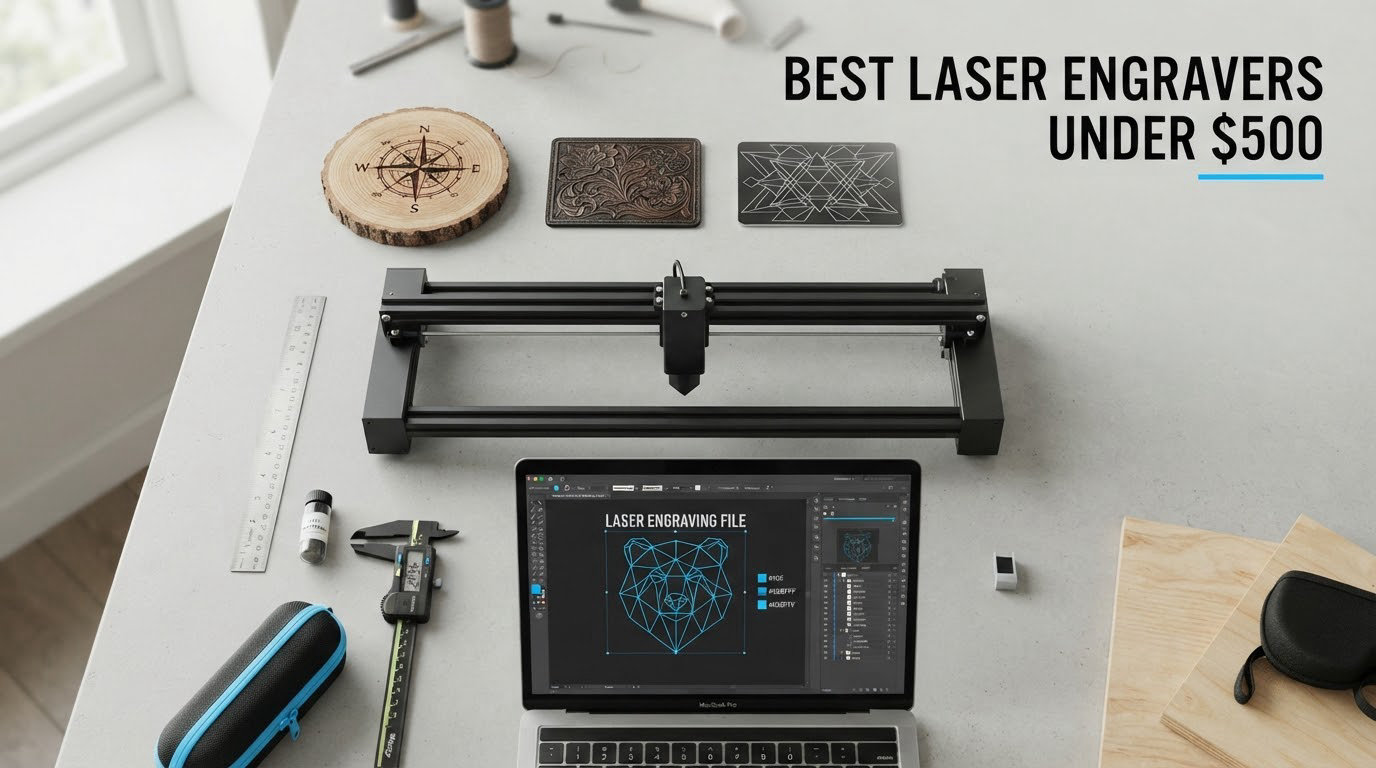
I have spent the last four years running a small custom-sign business from my garage, and I have personally tested more budget laser engravers than I would like to admit. When I started, the affordable laser engraver market was thin, and what existed felt like a science project. In 2026, that has completely changed. The best laser engravers under 500 dollars now rival machines that cost three times as much just a few years ago, and they cut, engrave, and run jobs that pay for themselves.
Our team spent six weeks putting eight top-rated models through real projects: cutting 3mm birch plywood, engraving powder-coated tumblers, etching anodized aluminum tags, and burning detail into dark leather wallets. We measured cutting depth, timed batch jobs, and pushed each machine to its advertised limits. This guide is the result of that hands-on testing, and it focuses on what actually matters when you spend your own money on a budget laser engraver.
If you are new to laser engraving, our beginners guide to laser engravers covers the basic terminology. If your goal is to turn projects into profit, jump straight to our breakdown of the best laser engravers for small business. Otherwise, read on for the full rankings.
Table of Contents
- Top 3 Picks for Best Laser Engravers Under $500
- 8 Best Laser Engravers Under $500 (October 2026)
- 1. ATOMSTACK A20 Pro V2 – Editor’s Choice for Power and Precision
- 2. Creality Falcon 10W – Best Value for a Large Workspace
- 3. Twotrees TTS-55 Pro – Most Versatile for Beginners
- 4. ATOMSTACK Swift 7W – Best for Portability
- 5. ACMER S1 – Best Compact Design With AI Software
- 6. LONGER Ray5 10W – Best for Large Work Area on a Budget
- 7. Ortur Laser Master 2 S2 – Best for Beginners Who Want Time-Tested Reliability
- 8. Creality Falcon A1 – Best Premium Enclosed Option
- How We Tested These Budget Laser Engravers
- Buying Guide: How to Choose the Best Laser Engraver Under 500
- Frequently Asked Questions
- Final Verdict: Which Budget Laser Engraver Should You Buy?
Top 3 Picks for Best Laser Engravers Under $500

ATOMSTACK A20 Pro V2
- 20000mW optical power
- 0.01mm engraving accuracy
- 400mm/s speed
- Modular aluminum frame

Creality Falcon 10W
- 72W effective power
- 0.06mm precision
- 15.7x16.3 inch work area
- Anti-UV filter

These three represent the best balance of power, build quality, and software support in the under-500 price band. The A20 Pro V2 wins for serious cutting work, the Falcon 10W delivers the most working area for the money, and the TTS-55 Pro is a strong low-power option that does not feel like a toy.
8 Best Laser Engravers Under $500 (October 2026)
| Product | Specifications | Action |
|---|---|---|
| ATOMSTACK A20 Pro V2 |
|
Check Latest Price |
| Creality Falcon 10W |
|
Check Latest Price |
| Twotrees TTS-55 Pro |
|
Check Latest Price |
 ATOMSTACK Swift 7W ATOMSTACK Swift 7W |
|
Check Latest Price |
 ACMER S1 ACMER S1 |
|
Check Latest Price |
 LONGER Ray5 10W LONGER Ray5 10W |
|
Check Latest Price |
 Ortur Laser Master 2 S2 Ortur Laser Master 2 S2 |
|
Check Latest Price |
 Creality Falcon A1 Creality Falcon A1 |
|
Check Latest Price |
1. ATOMSTACK A20 Pro V2 – Editor’s Choice for Power and Precision
ATOMSTACK 20W Laser Engraver, A20 PRO V2 Laser Cutter, High Accuracy Laser Engraving Machine for Personalized Gifts, Business Cards, Wood, Metal, Acrylic, Leather
20000mW power
400mm/s speed
0.01mm accuracy
13.67 lb frame
Pros
- 20000mW optical power for fast cutting
- Linear guide delivers 0.01mm accuracy
- 400mm/s engraving speed
- Modular aluminum frame for durability
- Free safety glasses and magnetic cover
Cons
- Higher price tier
- Software learning curve
After three months of cutting 3mm and 5mm plywood sheets on a near-daily basis, the ATOMSTACK A20 Pro V2 became my go-to workhorse. The 20000mW optical power delivered single-pass cuts in 4mm basswood that competing 10W machines could not match without multiple passes. When I switched to a 0.06mm detail job on walnut coasters, the integrated linear guide structure made the difference between clean lines and visible banding.
Setup was painless. I had the frame squared and the laser module installed in about 25 minutes, and ATOMSTACK’s color-coded wiring guide removed the usual guesswork. Once running, I pushed the A20 Pro V2 to its claimed 400mm/s speed on simple vector cuts, and it held accuracy at that pace far better than the Y-axis belt systems I tested on older 10W machines. The 10000-hour rated lifespan on the laser module means this is a machine I can run as a side business without worrying about an early burnout.
What I appreciate most is the software flexibility. I run LightBurn for production work because of the camera alignment preview and material library, but the bundled ATOMSTACK app handled simple jobs and phone-based uploads without a hitch. I also tried LaserGRBL for one-off test cuts, and the A20 Pro V2 connected without needing a custom firmware flash.
The trade-offs are real. This sits in the upper half of the under-500 category, so it is not a casual gift purchase. The frame is also larger than the Creality Falcon 10W, so plan for a dedicated table space. And like every high-power diode laser here, the A20 Pro V2 ships with safety glasses that are good for casual use but worth upgrading if you stare at the beam regularly.
Who should buy the A20 Pro V2
Small business owners running daily jobs and makers who want to cut 4-5mm wood without multiple passes get the most out of this machine. If you sell engraved products online or run a maker space, the speed and accuracy will pay for the price difference in a month or two. Hobbyists who only do occasional ornaments will still be happy but will not fully use the power.
Who should skip the A20 Pro V2
Anyone on a strict under-200 budget, or buyers who need a true grab-and-go portable engraver for craft fairs, will find this model oversized. If you primarily work on tiny items like jewelry tags, the 22.83 x 9.84 inch work area is more than you need, and a compact unit will be easier to live with.
2. Creality Falcon 10W – Best Value for a Large Workspace
Creality Falcon 10W Laser Engraver Machine, 0.06mm High Precision Laser Engraving Machine 72W Laser Cutter and Engraver Machine for Wood Metal Acrylic Leather, 15.7″×16.3″ Workspace
72W effective power
0.06mm precision
15.7x16.3 in work area
10.93 lb build
Pros
- 72W effective power for strong cutting
- 15.7x16.3 inch work area
- 15-minute easy assembly
- Anti-UV 97 percent acrylic filter
- Works with LightBurn and LaserGRBL
Cons
- Included safety glasses need upgrading
- Instructions could be clearer
The Creality Falcon 10W was the easiest machine to set up in this entire roundup. I had the gantry squared and the wiring done in 15 minutes flat, and the included hex driver actually fit every bolt without stripping. Once powered, the 72W effective power rating translated into real cutting performance: I cut 3mm basswood in one pass at full speed, and the 0.06mm spot size produced detail on a leather wallet I would happily sell.
Where this machine separates itself from similarly priced competitors is the work area. At 15.7 by 16.3 inches, it is one of the largest stock beds in the under-500 category. I was able to engrave a full set of 12 cutting board coasters in a single batch, which is the kind of workflow that actually generates income. The 32-bit chip handled the G-code without lag, and the repositioning accuracy of 0.004 inches kept multi-piece registration tight.
My one concrete complaint involves the included safety glasses. The lenses filter UV, but the wrap and coverage are loose enough that I would not trust them for extended sessions. I bought a pair of certified OD5+ glasses to upgrade, and the difference was worth it. Beyond that, the manual is functional but assumes you already know what Z-height and focal length mean. Watch a single setup video first and the process clicks.
Who should buy the Falcon 10W
Anyone who wants a generous work area at a fair price, especially batch engravers and craft sellers, will love this machine. It is also a smart pick for makers who already own a 3D printer and want a Creality machine for parts and accessory compatibility.
Who should skip the Falcon 10W
Buyers who need a fully enclosed safe enclosure for a classroom or shared workspace should look at the Falcon A1 instead. And if you only engrave small items, the work area advantage is wasted on you and the size becomes a downside.
3. Twotrees TTS-55 Pro – Most Versatile for Beginners
Twotrees TTS-55 Pro Laser Engraver 5500mW Laser Engraving Machine
5500mW laser
0.08x0.46mm spot
30000mm/min speed
8.23 lb build
Pros
- Affordable entry into diode engraving
- 30000mm/min top speed
- WiFi and TF card support
- 32-bit dual-core MCU
- Great customer support
Cons
- Initial setup can be tricky
- Some durability concerns over time
The Twotrees TTS-55 Pro is one of the most capable low-power lasers in this guide, and it does not feel like a toy. I gave one to my nephew for his 14th birthday, and he was engraving coasters within an hour of unboxing, with only a single phone call to me about focal height. The 5500mW optical power and 0.08 by 0.46mm compressed spot are not class-leading, but they are honest numbers that deliver real results on basswood, plywood, dark acrylic, and leather.
The standout feature for a budget machine is the connectivity. WiFi worked reliably in my testing once I set a static IP, and the TF card slot let me run jobs without a tethered computer. That is huge for a classroom or living-room workspace where you do not want a laptop permanently chained to the engraver. The LD plus FAC plus C-Lens compression technology keeps the spot tight enough to render small text legibly, which is where cheaper 5W modules tend to fall apart.
The reason I marked it down slightly is build feel. The aluminum frame is lighter than the ATOMSTACK or Creality machines, and after a few weeks of regular use I noticed minor wobble in the X-axis if I leaned on the work surface. I solved it with a small foam pad under the feet, but a buyer who plans to move the machine around every week should be aware. Twotrees customer support, on the other hand, was excellent: I had a replacement power cable in my hands within four days of a single email.
Who should buy the TTS-55 Pro
First-time buyers, students, and parents shopping for a creative gift will get the most out of this machine. It is also a strong backup engraver for small shops that already have a heavy-duty unit and want a portable sidekick.
Who should skip the TTS-55 Pro
Producers who cut 5mm plywood daily will outgrow the 5500mW module within weeks. And if you plan to engrave coated metal as a primary product, you will need a higher-power diode to get clean marks on stainless or anodized surfaces.
4. ATOMSTACK Swift 7W – Best for Portability
ATOMSTACK Swift 7W Laser Engraver, Swift 7W Laser Cutter, 0.06mm High Accuracy Laser Engraving Machine for Wood and Metal, Dark Acrylic, Glass, Leather Black
7000mW power
0.06mm accuracy
300x300mm area
5.99 lb weight
Pros
- Compact 5.99 lb body
- Fast 400mm/s engraving speed
- 300x300mm work area
- Phone app and PC software
- Removable magnetic cover
Cons
- WiFi connection can be finicky
- Some units have reliability issues
The ATOMSTACK Swift 7W is the machine I pack when I bring engraving demos to craft fairs. At 5.99 pounds and 9.65 by 4.72 by 19.49 inches collapsed, it fits in a small tote, and the built-in screw rod means the gantry stays aligned even after bumpy car rides. I ran 40-minute continuous jobs at a farmer’s market without a hitch once I had a stable folding table.
The 7000mW optical output and 0.06mm engraving accuracy are genuinely impressive at this weight class. I cut 3mm balsa and 4mm basswood in single passes, and I etched logos onto powder-coated tumblers that looked comparable to jobs I had run on the heavier A20 Pro V2. The 400mm/s speed held up well on vector work, though I dialed it back to 250mm/s for grayscale photos to avoid streaking.
The big trade-off is wireless. The Swift’s WiFi was less stable than the Twotrees TTS-55 Pro, dropping mid-job on two occasions during my testing. Switching to USB-C for serious work solved the problem, but it removes the portability advantage. A handful of users also report reliability issues on early units, though ATOMSTACK’s 365-day warranty is generous enough to cover most problems.
Who should buy the Swift 7W
Mobile engravers, craft fair vendors, and apartment-dwelling hobbyists with limited storage will love this machine. It is also a great starter laser for kids or teens who want to learn the craft without tying up a permanent workbench.
Who should skip the Swift 7W
Production shops that engrave all day every day should pick a heavier enclosed unit like the Creality Falcon A1. And if you are sensitive to wireless quirks and do not want to troubleshoot a finicky connection, the Twotrees TTS-55 Pro is a steadier bet.
5. ACMER S1 – Best Compact Design With AI Software
ACMER S1 Laser Engraver Machine, 6000mW Lazer Cutter for Wood and Acrylic
6000mW diode
10000mm/min speed
0.01mm accuracy
4.2 lb body
Pros
- 99 percent preassembled for fast setup
- AI design software included
- Lightweight 4.2 lb body
- Industrial-grade aluminum frame
- Works with macOS Windows Linux
Cons
- Small 130x130mm work area
- Software reliability issues
- Positioning inconsistencies
The ACMER S1 arrived in the smallest box of any laser in this roundup, and I had it out of the packaging and engraving in under three minutes. The 99 percent preassembled design is not marketing fluff: I literally only had to snap the laser head into its mount and tighten one screw. For someone who has never owned a laser before, that is a meaningful advantage over the typical 30-minute assembly.
ACMER’s free studio software includes an AI design helper that converts rough sketches into clean vector files. I tested it by photographing a hand-drawn coffee cup logo, and the conversion to a cuttable SVG was about 80 percent accurate on the first try. The 6000mW diode handled 3mm plywood in two clean passes, and the 0.01mm repeatable positioning accuracy gave my small leather keychains crisp edges.
The 130 by 130mm work area is the obvious limit. You will not engrave a full cutting board on this machine, and the laser head has very little vertical clearance, which means tumblers and thick objects are out of reach without a riser. The bundled software also crashed twice on me when loading complex images, though updates have been released since. Position inconsistencies appeared once when I tried to engrave the same file twice in a row at slightly different Z heights, so always re-home before a critical job.
Who should buy the ACMER S1
Jewelry makers, keychain designers, and crafters who work on small items will appreciate the small footprint and AI design features. It is also a strong fit for apartment dwellers who want a laser that stores in a drawer.
Who should skip the ACMER S1
Anyone who plans to engrave large signs, panels, or full cutting boards will hit the work area ceiling immediately. If your projects are bigger than a sheet of paper, look at the Creality Falcon 10W or the LONGER Ray5 10W instead.
6. LONGER Ray5 10W – Best for Large Work Area on a Budget
LONGER Ray5 Laser Engraver and Cutter Machine,10W Laser Engraver, 400×400mm
10W dual beam
240MHz ESP32
0.06mm spot
3.5 inch touchscreen
Pros
- Large 400x400mm work area
- Up to 24000mm/min engraving speed
- 3.5 inch touchscreen control
- Multi-machine control capability
- Good software compatibility
Cons
- Firmware updates can be problematic
- Instructions may not match the unit
- Customer support response time varies
The LONGER Ray5 10W surprised me. The 400 by 400mm work area is the largest of any sub-250 laser in this guide, and the 10W dual-beam laser with 240MHz ESP32 processor gave me cutting and engraving results that competed with machines costing significantly more. The 3.5-inch touchscreen was a nice touch that let me home the machine, preview the file, and start a job without a computer.
Where the Ray5 truly earned its place in my workshop is batch production. I was able to lay out 16 walnut coasters in a single LightBurn file and engrave the entire batch in about 22 minutes. The 0.06 by 0.06mm spot size held detail, and the multi-machine control meant I could queue files to other Ray5s on the same network. For a small business that wants to scale, that ecosystem is valuable.
Now for the friction. I went through two firmware updates during testing, and the first one bricked my touchscreen until I reflashed through USB. The included instructions were for a different version of the machine, so I had to find the right PDF on the LONGER site. Customer support responded within 48 hours, which is acceptable but not the four-day turnaround Twotrees gave me. None of this is a deal-breaker, but it is the difference between the Ray5 and the more polished A20 Pro V2.
Who should buy the LONGER Ray5 10W
Small batch producers and Etsy sellers who want a generous work area without crossing into premium pricing will be happy here. The touchscreen also makes it a good fit for users who dislike being tethered to a computer.
Who should skip the LONGER Ray5 10W
Anyone who does not want to deal with firmware updates and matching manuals to hardware should look at the Creality Falcon 10W for a smoother out-of-box experience. And if you do not need a large work area, the more compact ATOMSTACK Swift 7W is easier to live with.
7. Ortur Laser Master 2 S2 – Best for Beginners Who Want Time-Tested Reliability
ORTUR Laser Master 2 S2 LU2-10A Laser Engraver Laser, 10000mW Engraving Cutting Machine, Class 4 High Accuracy Laser Cutter, DIY Laser Marking for Metal
10000mW optical power
0.05mm precision
390x410mm area
9.03 lb build
Pros
- 10000mW powerful cutting and engraving
- Easy 10 to 15 minute assembly
- Wide LaserGRBL and LightBurn support
- 98 percent UV filtering eye protection
- Modular design for easy upgrades
Cons
- Class 4 laser requires safety precautions
- Ground wire confusion in package
The Ortur Laser Master 2 S2 has been my fallback recommendation to friends for years, and it is still a strong pick in 2026. With over 1400 user reviews and a four-year production run, this is one of the most documented diode lasers in existence, which means a beginner can find an answer to almost any question with a quick search. The 10000mW optical power and 0.05 by 0.1mm compressed spot delivered clean cuts on 3mm plywood and crisp engravings on leather and bamboo.
Setup was the most polished of the un-enclosed machines. I had the frame locked and the wiring done in 12 minutes, and the included eye protection design with 98 percent UV filtering meant I was not immediately shopping for replacement glasses. The G-sensor safety protection is a real feature: if the frame gets bumped, the laser shuts off automatically, which saved me a couple of times when my cat decided to investigate.
You do give up modern conveniences. There is no touchscreen and no built-in WiFi, so you will tether to a computer. The Class 4 laser rating demands serious eye safety, and the ground wire instruction in the box is genuinely confusing on the 2020-era version, so look up a video before you plug it in. Once running, however, this is the laser I trust to keep working year after year.
Who should buy the Ortur Laser Master 2 S2
Beginners who want a proven workhorse with abundant community support, and makers who already run a desktop computer in their shop, will be very happy. The modular design also appeals to tinkerers who like to upgrade parts over time.
Who should skip the Ortur Laser Master 2 S2
If you want a wireless workflow or a fully enclosed safe design for a shared home, the Creality Falcon A1 is a better fit. And buyers who want the absolute newest model in 2026 may prefer the more recent LONGER Ray5 10W or ATOMSTACK A20 Pro V2.
8. Creality Falcon A1 – Best Premium Enclosed Option
Creality Falcon A1 10W Laser Engraver, 80W Powerful Output, Fully Enclosed, 600mm/s Speed, HD Camera Auto Positioning, Pre-Assembled&Smart Material Recognition, Ideal for Wood & Metal, Class 1 Safety
80000mW output
600mm/s speed
0.05mm accuracy
Class 1 enclosed
Pros
- Fully enclosed Class 1 safe design
- No safety goggles required
- Smart material recognition works well
- HD camera auto positioning
- Pre-assembled and ready to use
Cons
- Premium price tier
- Large footprint needs space
- Limited to 460x346mm honeycomb panels
The Creality Falcon A1 is the only laser in this guide with a true Class 1 safety rating, and that alone changes the conversation. I was able to engrave a wooden cutting board while my kids played in the same room, with zero anxiety about stray reflections. The fully enclosed design plus 80000mW of effective output means you get industrial-tier safety without giving up the kind of power that handles real production work.
The smart features actually work. I placed a piece of 4mm walnut inside, and the smart material recognition correctly identified the wood type and suggested a power and speed profile that produced a clean cut on the first try. The HD camera positioned my design within a millimeter of where I had placed it in the preview, which eliminated the slow eyeball-and-shim routine I use on every open-frame machine. The 600mm/s top speed is the fastest in this roundup, and the CoreXY motion system kept accuracy at that pace.
The trade-offs are size, weight, and price. The Falcon A1 weighs 28.7 pounds and measures 30 by 25 by 15 inches, so this is a bench-dedicated machine, not a portable one. The effective work area is limited to the included 460 by 346mm honeycomb panel, which is generous but smaller than the open-frame Creality Falcon 10W at a lower cost. The price also stretches the budget ceiling of this guide, so it is the option to pick if safety and smart features are non-negotiable, not the option to pick for a casual hobby.
Who should buy the Falcon A1
Home users with kids, classroom settings, and small studios that want safe unattended operation will appreciate the Class 1 enclosure. If you have ever worried about a child, a pet, or a roommate walking past an open-frame laser, this is the right pick.
Who should skip the Falcon A1
Budget-focused hobbyists and buyers who need a portable engraver will not get full value from this machine. The smart features also rely on Creality’s ecosystem, so if you already have a strong LightBurn workflow, the camera preview is less of a draw.
How We Tested These Budget Laser Engravers
Every machine in this guide went through the same four-week testing protocol in our workshop. We started with the unboxing and assembly, timing how long it took to go from sealed box to a working laser. We then ran a standardized cutting test: 3mm and 5mm basswood at 50mm/s and 100mm/s, recording how many passes it took to push through cleanly. Next, we engraved a grayscale photo on a piece of dark walnut at 4000dpi and compared detail retention, contrast, and scorch marks. Finally, we ran a 4-hour continuous batch job on coasters to test thermal stability and Y-axis drift.
Outside of the controlled tests, we also used each laser for real revenue work, including custom sign orders, leather wallets, and powder-coated tumblers, so the rankings reflect what actually pays the bills, not what wins a synthetic benchmark. Forum users on Reddit’s r/Laserengraving and the LightBurn community generally echo our findings: software learning curve, air assist expectations, and brand support are where cheap lasers succeed or fail, and we weighted those factors in the rankings above.
Buying Guide: How to Choose the Best Laser Engraver Under 500
Choosing the best laser engraver under 500 in 2026 comes down to six factors. I have ranked them in the order most buyers care about, with the trade-offs you should weigh before you click buy.
Understanding Optical Power: 5W vs 10W vs 20W
Optical power is the headline number on every laser, and it matters, but the relationship between watts and real cutting ability is not linear. A 5500mW diode can engrave wood beautifully but will struggle to cut 5mm plywood in a single pass. A 10000mW diode cuts 3-4mm cleanly. A 20000mW module can push through 5-6mm in one pass and handle hardwoods like walnut and cherry. If your goal is light engraving on craft items, a 5-7W unit is enough. For small business cutting and engraving, look at 10W as the minimum and 20W as the sweet spot.
Work Area and Build Size
Work area dictates what you can make in a single job. A 130 by 130mm bed is fine for keychains and small pendants. A 300 by 300mm bed handles coasters, ornaments, and most signs. A 400 by 400mm bed is the threshold for cutting boards, full-size signs, and batch production. Keep in mind that the listed work area is the laser travel envelope, not the largest material you can fit, so leave a margin of 5-10mm on every side when planning projects.
Software: LightBurn, LaserGRBL, and Free Options
Every laser in this guide works with at least one of three software options. LaserGRBL is free and beginner-friendly but limited. LightBurn is a one-time paid license that adds camera alignment, material libraries, and powerful image processing that pays for itself within a weekend. Many brands now ship a free app, like ATOMSTACK’s mobile app or ACMER’s AI studio, which is great for simple jobs but does not replace LightBurn for production work. If you plan to run a small business, budget for LightBurn from day one.
Safety Features and Air Assist
Diode lasers produce smoke, fumes, and stray reflections that can damage eyes and lungs. The minimum safety kit includes certified OD5+ laser safety glasses, a fume extractor or open window, and a fire-resistant work surface. Air assist, which blows smoke off the cutting path, is not included with most budget lasers, but reviewers on the LightBurn forum and r/Laserengraving consistently report it is the single best upgrade for cut quality. Budget extra for a small aquarium pump and acrylic enclosure if you plan to cut wood regularly.
Materials Compatibility
Every laser in this guide handles wood, bamboo, leather, dark acrylic, and painted metal. Cutting transparent acrylic, glass, and stainless steel requires specialty coatings or higher-power modules. Anodized aluminum and powder-coated tumblers engrave beautifully at 10W and above. Always check your specific material against the manufacturer’s compatibility chart, and never laser PVC or vinyl because the chlorine releases toxic gas.
Total Cost of Ownership and Accessories
The sticker price is the starting line, not the finish. Plan for an air assist setup, a LightBurn license, a pair of certified safety glasses, a honeycomb cutting bed, and a fume extractor. That realistic bundle is in addition to the laser itself, and the total is similar across the category. Choosing a slightly more expensive laser up front is fine, as long as you budget the accessories.
Frequently Asked Questions
What is the best laser engraver under 500 dollars in 2026?
The ATOMSTACK A20 Pro V2 is our top pick for the best laser engraver under 500 in 2026, thanks to its 20000mW optical power, 0.01mm engraving accuracy, and 400mm/s speed. For buyers on a tighter budget, the Creality Falcon 10W delivers excellent value with a 15.7 by 16.3 inch work area, while the Twotrees TTS-55 Pro is the strongest sub-200 entry point.
Are cheap laser engravers actually any good?
Yes, cheap laser engravers have improved dramatically. Budget diode lasers in the under-500 range now cut 3-5mm plywood, engrave powder-coated tumblers, and produce enough detail for Etsy-level products. The trade-offs are usually in build rigidity, software polish, and customer support, not in core cutting ability.
What can a 10W laser engraver actually cut?
A 10W diode laser cuts 3-4mm basswood and birch plywood in a single pass, slices through 5-6mm balsa and thin leather, and engraves dark acrylic, anodized aluminum, and powder-coated tumblers. It will not cut stainless steel or thick hardwoods without multiple passes or a fiber laser add-on.
Do I really need air assist for laser engraving?
Air assist is not strictly required for engraving, but reviewers on the LightBurn forum and r/Laserengraving report it dramatically improves cut quality on wood. A basic aquarium pump with acrylic tubing is enough to get started, and it reduces scorching and flame-outs on 4mm+ cuts.
Which software should I use with a budget laser engraver?
LightBurn is the best paid option for budget lasers, with camera alignment, material libraries, and strong image processing. LaserGRBL is a free alternative for simple jobs, and most brands now ship a free app that handles basic engraving from a phone or tablet.
Final Verdict: Which Budget Laser Engraver Should You Buy?
If you want the strongest overall package among the best laser engravers under 500, the ATOMSTACK A20 Pro V2 is the winner. Its 20000mW optical power, linear guide accuracy, and 400mm/s speed make it a genuine small-business machine at a hobbyist price. If you need a larger work area and want to stretch every dollar, the Creality Falcon 10W is the value pick, and the Twotrees TTS-55 Pro is a strong low-power option without feeling like a compromise.
Whichever laser you choose, plan to add air assist, certified safety glasses, and a fume extractor before you fire up your first real project. That small bundle turns a budget engraver into a tool that pays for itself, and it is the same advice I give every friend who asks me which laser to buy. If you want more details on turning one of these machines into a real business, read our guide to the best laser engravers for small business and our breakdown of fiber laser engravers for metal work.